
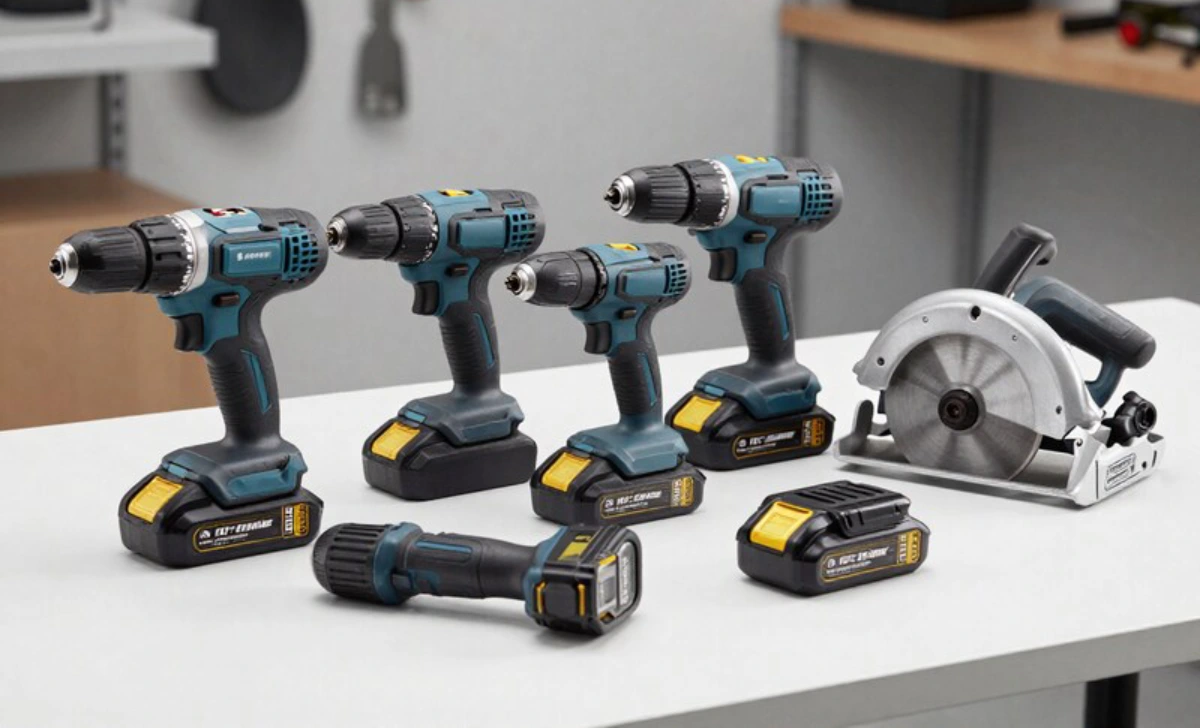
The global battery power tools market reached $20.77 billion in 2020 and is projected to grow to $41.2 billion by 2030. This 6.9% compound annual growth rate shows that consumers continue to choose cordless power tools over corded models.
What should you know before making the switch? Here are the main advantages and disadvantages.
The Advantages of Cordless Power Tools
Cordless power tools run on rechargeable battery packs instead of requiring a continuous electrical connection. This design shift creates several practical benefits.
Greater Portability and Movement Freedom
Without a power cord, you can work anywhere without searching for outlets or managing extension cords. You can move freely around job sites, work in tight spaces, and reach awkward angles without cord tangling or length restrictions.
This mobility becomes valuable when working outdoors, in unfinished spaces, or on roofs and scaffolding where electrical access is limited.
Improved Handling and Maneuverability
Removing the cord allows manufacturers to design tools with better weight distribution and ergonomics. You can rotate and position tools more naturally without a cord pulling or catching.
This improved handling reduces fatigue during extended use and gives you better control during precision tasks.
Lighter Weight for Reduced Fatigue
Most cordless models weigh less than their corded counterparts. Smaller motors and battery-powered designs reduce overall tool weight, making them easier to carry and use for longer periods.
Lower-voltage models (12V–20V) work well for light-duty tasks and minimize strain during overhead or repetitive work.
The Disadvantages of Cordless Power Tools
Cordless tools offer convenience, but they come with trade-offs you should consider.
Lower Power Output for Heavy-Duty Tasks
Cordless power tools typically deliver less power than corded models. Battery voltage limits torque and speed, which can slow down demanding applications like cutting thick materials or drilling through masonry.
Professional contractors often keep corded tools for heavy-duty work and use cordless models for light to medium tasks.
Higher Upfront Cost
Cordless tools cost more than equivalent corded versions. You pay for the battery technology, charger, and convenience features.
Lithium-ion batteries add to the initial expense, though prices have decreased as the technology has matured. Buying into a battery platform (where multiple tools share the same battery system) can offset costs over time.
Battery Runtime and Recharging Limits
Battery life varies based on tool voltage, battery capacity (measured in amp-hours), and how you use the tool. High-demand tasks drain batteries faster.
Recharging takes 30 minutes to several hours, depending on battery size and charger type. Many users buy extra batteries to swap in when one runs out, but this adds to the total cost.
Battery performance also degrades over time. After several hundred charge cycles, you may notice shorter runtimes before needing a replacement.
Consider your specific needs before choosing cordless tools. Professionals with access to power outlets may prefer corded models for sustained power, while DIY users and mobile workers benefit more from cordless convenience.