
Key Takeaways
- Set a realistic budget that includes the full cost of ownership.
- Compare out-the-door prices, fees, and financing offers.
- Choose a vehicle based on your island driving, parking, passenger, and cargo needs.
- Consider fuel, charging, insurance, maintenance, and registration costs.
- Inspect used vehicles carefully and check their recall history.
- Take a thorough test drive before making a decision.
- Review all contracts, warranties, fees, and optional products before signing.
- Keep important documents and emergency savings after the purchase.
Buying a vehicle in Hawaii can be exciting, but the best decisions happen well before you sign paperwork. Island driving brings its own considerations, including parking, fuel costs, weather exposure, shipping availability, service access, and county registration requirements. Whether you are replacing an older commuter car or shopping for a family vehicle, a clear plan can help you avoid a purchase that strains your budget. Start by focusing on your needs and total ownership costs rather than an advertised monthly payment. Before visiting a showroom or contacting a private seller, Learn More about available new and pre-owned options, then create a comparison list based on price, condition, features, and long-term practicality.
Set a Realistic Car-Buying Budget
Your budget should cover the entire transaction and the months that follow. Include your down payment, loan interest, insurance, fuel, registration, routine maintenance, and a reserve for repairs. A vehicle may fit within a monthly payment but still be unaffordable when all related expenses are factored in. For example, a lower payment on a longer loan can make a more expensive vehicle appear manageable. However, extending the repayment period usually means paying more interest and remaining in debt longer. Keep enough savings available after the purchase for household emergencies, tires, batteries, or unexpected repairs.
Build an out-the-door number
- Vehicle selling price
- Taxes, registration, and title-related charges
- Dealer fees and installed accessories
- Optional warranties or protection products
- Down payment and trade-in credit
Choose the Right Vehicle for Island Driving
Match the vehicle to how you actually drive. Consider commute distance, hills, passenger needs, beach or work equipment, parking space, and whether local service is convenient. Compact cars can make sense for tight urban parking, while crossovers may provide useful cargo space without the size and fuel use of a full-size SUV. Trucks can be valuable for work, hauling, and recreation, but they may have higher fuel, tire, and maintenance costs. Hybrid and electric vehicles deserve a separate evaluation. Consider home charging access, daily mileage, public charging convenience, battery warranty coverage, and whether the vehicle fits your typical travel patterns.
Research Prices, Fees, and Availability
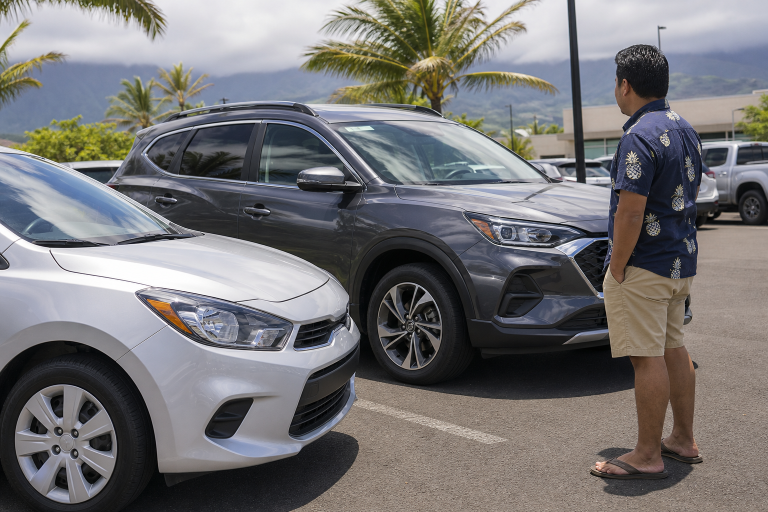
Compare at least three similar vehicles before committing to one. Ask each seller for an itemized out-the-door price so you can separate the vehicle price from required charges and optional add-ons. Practical car-buying guidance also recommends considering insurance, fuel, maintenance, registration costs, vehicle history, and the total price before purchase.
- Confirm that advertised incentives apply to your credit profile and purchase terms.
- Ask whether accessories and protection products are optional.
- Compare warranty coverage, mileage limits, and deductibles.
- Check availability before relying on a specific model or trim.
- Request an explanation for every charge you do not recognize.
Compare Financing Before Visiting a Dealer
Shop for financing before you shop for a payment. A bank or credit union’s pre-approval gives you a benchmark for the annual percentage rate, loan term, and total interest. You can then compare that offer with dealer-arranged financing and select the option that is genuinely less expensive. Do not judge a loan only by its monthly payment. A 60-month loan may cost more per month than an 84-month loan, but the shorter loan can substantially reduce total interest. Review whether the loan has early payoff penalties, required products, or conditions that change the quoted rate.
Inspect a Used Vehicle Carefully
A vehicle history report is useful, but it is not a substitute for inspection. Confirm that the vehicle identification number matches the title and sales documents. Review mileage, title status, ownership history, reported damage, service records, and any warranty terms. A clean report does not guarantee that every repair, accident, or problem was recorded. Look for uneven tire wear, corrosion, fluid leaks, warning lights, mismatched paint, damaged trim, and unusual engine noises. Before buying, use the VIN to check for unrepaired safety recalls and, when possible, arrange an independent inspection with a mechanic you trust.
Make the Test Drive Count
A short drive around the block is rarely enough. Try to replicate normal use by driving on local streets and, when practical, at highway speeds. Start the vehicle cold if possible, turn off the radio, and listen for rattles, vibrations, brake noise, or harsh shifting.
- Test acceleration, steering response, braking, and transmission operation.
- Adjust the seat and mirrors to assess comfort and visibility.
- Check air conditioning, windows, lights, wipers, cameras, and driver-assistance features.
- Inspect the cargo area and look underneath the vehicle after the drive.
Review the Full Purchase Contract
Slow down before signing. The buyer’s order and financing documents should clearly show the selling price, trade-in value, down payment, loan amount, interest rate, term, fees, and every optional product. If a discount, repair, accessory, or promise matters to your decision, make sure it appears in writing. Read the service contract, GAP coverage, theft protection, and extended warranty terms carefully. Do not assume that a standard vehicle sale includes a general right to cancel after signing. Keep complete copies of every signed document, including disclosures, warranty information, and any agreed repair commitments.
Plan for Insurance and Registration
Get an insurance quote before finalizing the purchase, ideally using the exact VIN. Premiums can vary by vehicle, driver, coverage limits, deductible, location, claims history, and financing requirements. Confirm the coverage you need, including liability, collision, comprehensive, and uninsured motorist protection where appropriate. Registration steps can vary by county and by whether the vehicle is new, used, financed, or newly brought to Hawaii. Keep your bill of sale, title-related documents, lender information, proof of insurance, and safety inspection records organized so you are prepared for the applicable process.
Estimate the First-Year Ownership Cost
The first year often costs more than buyers expect. Plan for oil and filter service, tire rotations, brake checks, battery testing, registration renewal, accessories, parking, and possible repairs. Set aside a monthly amount for maintenance rather than waiting for a warning light or worn tire to force an unplanned expense.
Use a Final Pre-Purchase Checklist
- The vehicle fits your household, commute, parking, and cargo needs.
- You know the full out-the-door price.
- You compared financing offers and total interest costs.
- You received an insurance quote.
- You reviewed the vehicle history, condition, and recall status.
- You completed a meaningful test drive and independent inspection.
- You understand warranty terms, fees, and optional products.
- Every important promise is included in writing.
- You will retain emergency savings after the purchase.
Conclusion
A smart car purchase is not simply about finding the newest model or the lowest listed price. It is about choosing a vehicle that fits your daily life, financial goals, and long-term ownership plan. By comparing vehicles, inspecting carefully, reviewing financing, and reading every document before signing, Hawaii buyers can move forward with greater confidence. Taking time to consider fuel or charging costs, insurance, maintenance, safety features, and resale value can also help prevent unexpected expenses and make ownership more manageable.