
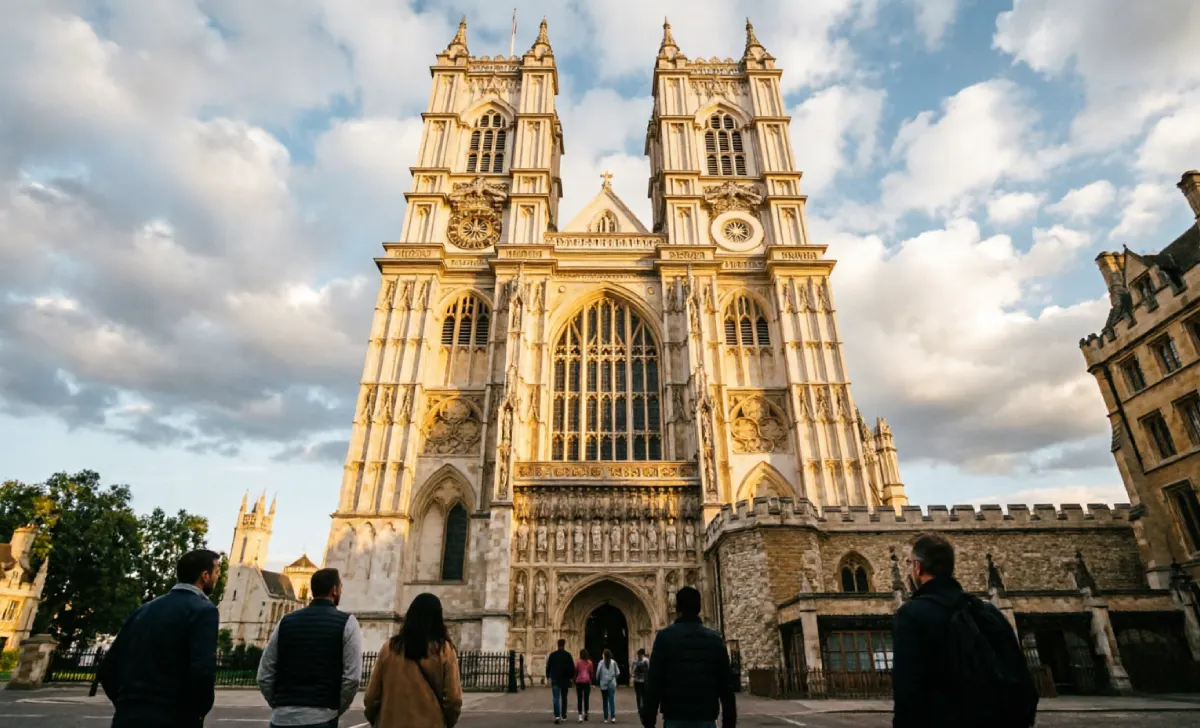
Westminster Abbey is more than just a beautiful historic building in London, England. It’s a living piece of British history that has witnessed coronations, royal weddings, funerals, and daily worship for nearly a thousand years. If you’re planning a trip to London or simply curious about this iconic landmark, you’ve probably asked yourself: What makes Westminster Abbey so special? How much time do I need to visit? Is it worth the ticket price? This Westminster Abbey visitor guide answers those questions and more.
You’ll discover fascinating facts about Westminster Abbey, practical visitor tips, and the deep historical significance that draws over 1.5 million people every year.
What Is Westminster Abbey? A Quick Overview
Many visitors confuse Westminster Abbey with a cathedral or a parish church. In fact, it’s neither. Westminster Abbey is officially known as the Collegiate Church of Saint Peter at Westminster. It’s what’s called a “royal peculiar,” meaning it falls directly under the jurisdiction of the British monarch, not the Church of England’s diocesan structure.


The Abbey was founded in 960 by King Edward the Confessor, though the current Gothic building mostly dates from the 13th to 16th centuries. Since 1066, it has been the traditional coronation site for English and later British monarchs. William the Conqueror started that tradition, and King Charles III was the 40th monarch to be crowned here in 2023. Any Westminster Abbey visitor should understand this royal connection—it’s what makes the Abbey unique among London’s historic churches.
Why Do Visitors Come to Westminster Abbey?
When readers search for information about Westminster Abbey, they typically have a few common questions. Let’s address them directly.
Is Westminster Abbey Worth Visiting?
Absolutely. Most visitors spend 90 minutes to two hours exploring. The audio guide is excellent and included with admission. You’ll see the Coronation Chair (used since 1300 for every coronation), the Tomb of the Unknown Warrior, Poets’ Corner, and the stunning Gothic architecture with its massive stained glass windows.
One concern visitors often share is the queue. On busy days (especially summer weekends and school holidays), lines can stretch for 30–45 minutes. Book tickets online in advance to skip the main queue, and arrive right when it opens at 9:30 AM (Wednesday–Sunday).
How Much Does It Cost?
As of 2025, adult tickets cost around £27 online. Children (6–17) pay £12, and under-5s enter free. Concessions are available for students and seniors. Westminster Abbey tours with guides cost extra but offer deeper access to areas like the 13th-century Chapter House and the rarely-seen triforium galleries. Every Westminster Abbey visitor should budget for at least 2–3 hours to see everything properly.
Can You Attend a Service for Free?
Yes. This is one of the most practical tips locals share. Westminster Abbey is a working church first and a tourist attraction second. Daily services (Morning Prayer, Eucharist, and Evensong) are completely free to attend. You won’t get to wander the whole building, but you’ll experience the Abbey as it was meant to be: as a place of worship. Check the schedule online before you go.
Architectural Marvel: Gothic Design and Hidden Details
Westminster Abbey is considered one of the world’s finest examples of Gothic architecture. But what does that actually mean for someone walking through its doors?
Look up, and you’ll see fan-vaulted ceilings that seem to float. The Abbey comprises over 3,000 individual stones, many brought from Caen in France during the 12th century. The stained glass windows are enormous—the Rose Window in the north transept measures over 16 feet high.
The western towers were a later addition. Designed by Nicholas Hawksmoor and completed in 1745, they give the Abbey its iconic skyline silhouette. Before that, the Abbey looked very different, with only a central tower.
One detail most visitors miss: the Chapter House door. It’s one of the oldest surviving wooden doors in Britain, dating from the 1050s. Historians believe it may have been covered in animal skin (possibly human, according to folklore, though that’s unproven).
Royal History: Coronations, Weddings, and Burials
Seventeen British monarchs are buried in Westminster Abbey, including Henry VIII, Elizabeth I, and Mary Queen of Scots (though her body was later moved). Edward the Confessor’s shrine stands behind the High Altar, the Abbey’s holiest spot.
Coronations Since 1066
William the Conqueror started the tradition on Christmas Day, 1066. Every subsequent English and British monarch has been crowned here except two: Edward V (who was probably murdered before his coronation) and Edward VIII (who abdicated). The Coronation Chair still holds pride of place. Originally, it held the Stone of Destiny, a Scottish relic that Edward I captured. That stone now lives in Edinburgh Castle but returns for coronations.
Royal Weddings
The Abbey has hosted 16 royal weddings, including Prince William and Kate Middleton in 2011. Other notable weddings include Princess Margaret (1960), Princess Anne (1973), and Prince Andrew (1986). Queen Elizabeth II’s wedding in 1947 took place here too, though she married Prince Philip at Westminster Abbey as a princess, not yet queen.
Burials and Memorials
Being buried in Westminster Abbey is one of Britain’s highest honors. You’ll find the tombs of Isaac Newton, Charles Darwin, and Geoffrey Chaucer in what’s called Poets’ Corner. But that name is misleading—Poets’ Corner also honors writers like Jane Austen, the Brontë sisters, and even actors like Laurence Olivier.
One grave you can’t miss: the Tomb of the Unknown Warrior. This single grave contains the remains of an unidentified British soldier from World War I. It’s the only grave in the Abbey that no one is allowed to walk over. Visitors instinctively walk around it. A thoughtful Westminster Abbey visitor will pause here to reflect—it’s one of the most moving spots in the entire building.
Famous Historical Figures Buried or Commemorated Here
Westminster Abbey is the final resting place for many famous British historical figures. Beyond Newton and Darwin, you’ll find:
- Geoffrey Chaucer (first buried in Poets’ Corner in 1400)
- Charles Dickens (buried here despite his wish for a small, private funeral)
- Thomas Hardy (his heart is buried separately in Dorset)
- Rudyard Kipling
- Stephen Hawking (his ashes interred in 2018 between Newton and Darwin)
One lesser-known fact: visitors can even see the spot where Queen Anne Boleyn was executed in 1536, though that happened at the Tower of London, not the Abbey. A small plaque near the Chapter House commemorates her.
Westminster Abbey as a Filming Location
Because of its grandeur and historical significance, Westminster Abbey has been featured in many films and TV shows. You might recognize it from:
- The King’s Speech (2010) – the coronation scene with Colin Firth
- Sherlock Holmes: A Game of Shadows (2011)
- The Other Boleyn Girl (2008)
- Harry Potter and the Half-Blood Prince (scenes inside the Chapter House)
- The Crown (Netflix series)
If you’re a film or TV fan, spotting these locations adds an extra layer of fun to your visit.
Practical Visitor Information
Opening Hours and Best Times to Visit
Westminster Abbey is typically open Wednesday–Sunday, 9:30 AM to 3:30 PM. It’s closed on Sundays for worship (except for services). The busiest months are June and September. The quietest times are late autumn and winter weekdays, especially Tuesday–Thursday mornings.
How to Get There
The Abbey is in the heart of London, across from the Houses of Parliament and Big Ben. The nearest Tube stations are Westminster (Jubilee, District, and Circle lines) and St. James’s Park (District and Circle lines). Many Westminster Abbey tours depart from Parliament Square.
Accessibility
The Abbey is mostly wheelchair accessible, with ramps at the Great West Door. Mobility scooters are allowed. There’s a lift to the Queen’s Diamond Jubilee Galleries (the triforium). Hearing loops are available at the ticket desk.
Photography Rules
No photography inside the main Abbey church. You can take photos in the Cloisters, Chapter House, and Gardens. This rule protects the art and prevents disruption to worshipers.
The Abbey as a Working Church
One of the most common misconceptions is that Westminster Abbey is just a museum. In reality, it’s an active place of worship every single day.
The Abbey hasn’t had a monastic community since the Dissolution of the Monasteries under Henry VIII in the 1540s. Today, it’s staffed by clergy and lay staff. But the daily rhythm of prayer continues: Morning Prayer, Holy Communion, and Choral Evensong.
The Westminster Abbey Choir is world-famous. Made up of 12 adult singers (lay vicars) and 30 boy choristers (students of the Abbey’s choir school), they perform Evensong most days except when on holiday. Attending Evensong is free and doesn’t require a ticket. It’s also the most authentic way to experience the Abbey.
Why Is Westminster Abbey Unique?
Let’s sum up what makes Westminster Abbey stand out from other historic buildings in the United Kingdom:
- Coronation church for 40 monarchs across nearly 1,000 years
- 16 royal weddings, including Prince William and Kate Middleton
- Final resting place for 17 monarchs and countless scientists, writers, and poets
- One of the world’s finest Gothic buildings with original 13th-century features
- A “royal peculiar” outside the normal church hierarchy
- An active place of worship with free daily services
- Over 1.5 million annual visitors make it one of London’s top tourist destinations
Every stone in Westminster Abbey seems to hold a story. It’s where the nation comes together to celebrate (royal weddings), to mourn (Princess Diana’s funeral in 1997 was held here, though she was not a royal at the time), and to mark pivotal moments (the Queen Mother’s funeral in 2002).
Final Tips for Your Visit
If you plan a trip to London, add Westminster Abbey to your itinerary. Book tickets online, arrive early, and take the audio guide. If you want a deeper experience, look for Westminster Abbey tours that include the Queen’s Diamond Jubilee Galleries, where you can see medieval manuscripts, funeral effigies, and the original coronation chair prototype.
And if you prefer a quieter, more spiritual visit, skip the tourist ticket altogether. Walk in for Choral Evensong at 5:00 PM (check the schedule). No ticket, no crowd, just voices echoing under those fan-vaulted ceilings. That’s the Abbey as it’s been for nearly a thousand years—and that’s the memory that will stay with you.
Disclaimer: This article is for general informational purposes only. Details such as ticket prices, opening hours, and service schedules may change. Visitors should check the official Westminster Abbey website before planning a trip.