
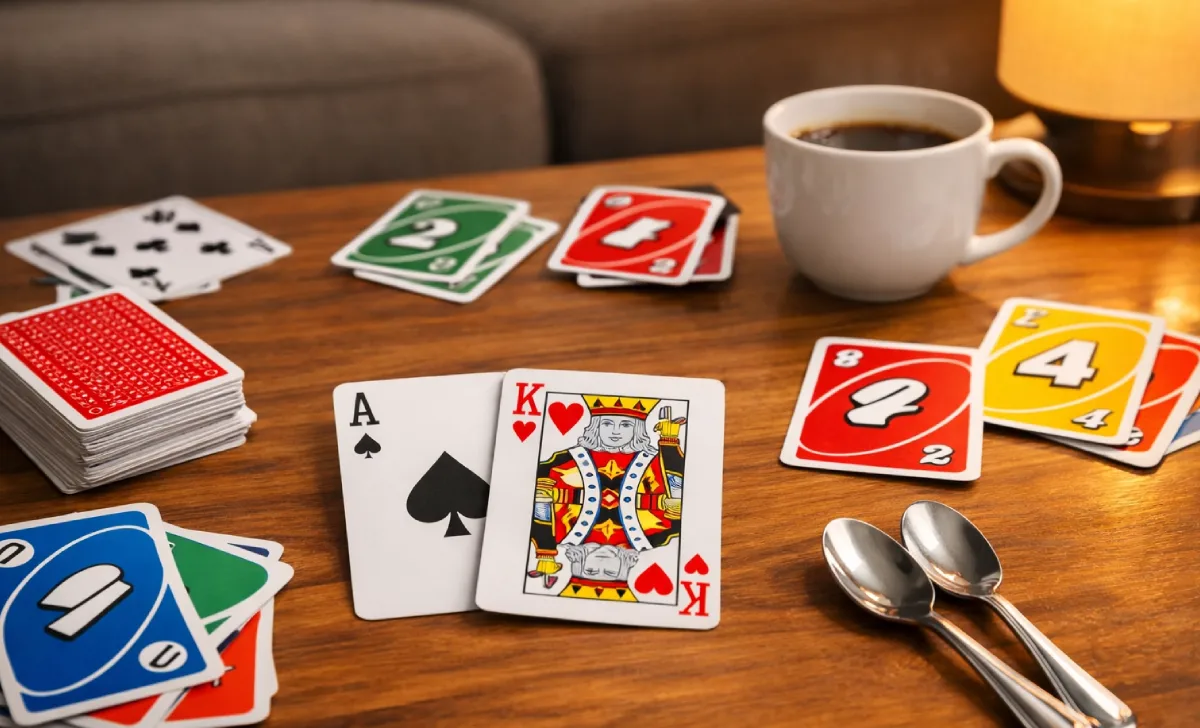
There’s something special about gathering around a table with a deck of cards. Whether it’s a quiet rainy afternoon or a lively game night with friends, card games have a way of bringing people together. They challenge your mind, spark laughter, and create moments you actually remember.
But with so many card games out there, which ones are truly worth learning? And more importantly, what makes them so appealing?
In this guide, we’ll walk you through six of the most thrilling card games—from solo classics to fast-paced group favorites. You’ll learn how each game works, why people love them, and which one might be the perfect fit for your next game night.


Why Card Games Still Matter Today
In an age of screens and notifications, card games offer something refreshingly real. They don’t require Wi-Fi, expensive equipment, or hours of setup. All you need is a standard deck (or a few specialty decks like Uno) and a willingness to have fun.
Card games also adapt to your mood. Feeling competitive? Try Blackjack or War. Want something relaxed? Solitaire has you covered. Hosting a family gathering? Spoons and Uno bring instant energy.
Plus, studies and common experience show that card games help improve memory, strategic thinking, and even social bonding. They’re not just entertainment—they’re genuinely good for you.
1. Solitaire – The Classic Solo Challenge
When people think of solo card games, Solitaire is usually the first that comes to mind. Specifically, Spider Solitaire has become a favorite for those who enjoy a quiet, thoughtful challenge.
How It Works
The goal of Spider Solitaire is simple: remove all cards from the board by arranging them in descending order from King to Ace within the same suit. Once you complete a full sequence, those cards are removed from play. It sounds straightforward, but the challenge comes from managing multiple columns and limited empty spaces.
What Makes It Appealing
- Perfect for one player – No need to wait for others.
- Deep strategy – Every move matters, and one wrong turn can cost you the game.
- Highly rewarding – Winning feels like solving a complex puzzle.
Common Reader Questions
- “Is Solitaire just luck?” – Partly, but skilled players win far more often by planning.
- “Can two people play Solitaire?” – Yes. Two-player Solitaire variants exist where players race to clear their boards first.
If you want to sharpen your skills, resources like vegassolitaire.com offer detailed guides on advanced strategies.
2. War – Simple, Fast, and Surprisingly Tense
Sometimes you don’t want complex rules. You just want to flip cards and feel the thrill of a close match. That’s exactly what War delivers.
How It Works
Two or more players split a standard deck equally. Each round, everyone lays down one card face up. The highest card wins all the cards in that round. If two cards are equal, it triggers a “war”: each player places three cards face down, then a final face-up card. The higher final card wins the entire war pile.
The game ends when one player collects all the cards.
What Makes It Appealing
- Zero learning curve – Kids and adults can play within seconds.
- Pure excitement – Wars create genuine suspense.
- Great for large groups – Works with 2 to 6+ players.
Real User Concerns
- “Isn’t War just luck?” – Mostly yes, but some players track which cards have been played to guess remaining high cards.
- “How long does a game take?” – Anywhere from 5 minutes to half an hour, depending on how many wars occur.
War won’t test your poker face, but it will give you quick, satisfying entertainment when you just want to unwind.
3. Blackjack – Skill, Strategy, and a Dash of Nerve
Blackjack is one of the most popular table games worldwide. Casinos love it, but it’s just as fun at home with friends—no real money required.
How It Works
Each player tries to get a hand value as close to 21 as possible without going over. Number cards are worth their face value, face cards are worth 10, and Aces can be 1 or 11.
Players receive two cards face up. The dealer gets one face up and one face down. Then, players choose to:
- Hit – Take another card
- Stand – Keep their current hand
- Double down – Double the bet and take exactly one more card
If you go over 21, you bust and lose. The dealer must hit until reaching at least 17.
What Makes It Appealing
- Easy to learn, hard to master – Basic rules take minutes, but card counting and advanced strategy take years.
- Fast-paced rounds – Games move quickly, keeping energy high.
- Social or serious – Play casually or competitively.
Common Questions
- “Should I always hit on 16?” – It depends on the dealer’s face-up card. Against a 7 or higher, hit. Against 2–6, stand.
- “Is Blackjack purely gambling?” – No. Strategy significantly improves your odds.
For home game nights, use chips or even just a pen and paper to track scores.
4. Table Game (Poker-Style) – Bluffing and Reading People
While the original article calls it “Table Game,” most readers will recognize this as a simplified version of poker. The core appeal isn’t just the cards—it’s the people across from you.
How It Works
Each player gets two cards face down (hole cards) and one card face up. Betting happens in rounds. You can win either by having the best hand at showdown or by bluffing so well that everyone else folds.
Common hands from high to low:
Royal Flush → Straight Flush → Four of a Kind → Full House → Flush → Straight → Three of a Kind → Two Pair → One Pair → High Card
What Makes It Appealing
- Psychological depth – Reading opponents is just as important as cards.
- Every hand is different – No two games feel the same.
- Low barrier, high ceiling – Easy to start, lifetime to master.
Real Discussions Among Players
- “How do I get better at bluffing?” – Start by betting consistently with strong hands, then occasionally with weak ones.
- “What if everyone folds every time?” – Raise more aggressively. Players will eventually call.
This game shines with 3 to 6 players. More than that, and rounds drag.
5. Spoons – Chaotic, Loud, and Hilarious
If your group loves laughter and controlled chaos, Spoons is a must-play. It’s less about strategy and more about speed and awareness.
How It Works
Place a set of spoons in the center of the table—one fewer than the number of players. Each player starts with four cards. The dealer passes one card at a time around the table, and players quickly discard unwanted cards to their left.
The goal: collect four of a kind. Once someone does, they quietly grab a spoon. Once one spoon is grabbed, everyone else scrambles for the remaining spoons. The player left without a spoon loses the round.
What Makes It Appealing
- Extremely fast-paced – Rounds last 1–2 minutes.
- Hilarious moments – Watching everyone dive for spoons never gets old.
- Works for all ages – Kids, teens, and adults love it.
Common Concerns
- “Can people get hurt?” – Yes, if spoons are grabbed aggressively. Use plastic spoons and set ground rules.
- “What if no one notices someone grabbed a spoon?” – That’s part of the fun. Players must stay alert.
Spoons are perfect for parties, family reunions, or any time you need a high-energy icebreaker.
6. Uno – Colorful, Fast, and Family-Friendly
No list of thrilling card games is complete without Uno. Since the 1970s, Uno has become a household name, and for good reason.
How It Works
Players start with seven cards. The top card of the deck is flipped face up to begin a discard pile. On your turn, you match either the number, color, or symbol of the top card.
Special action cards change the game:
- Skip – Next player loses their turn
- Reverse – Direction of play switches
- Draw Two – Next player draws two cards and skips
- Wild – Choose the next color
- Wild Draw Four – Choose a color, and the next player draws four
The first player to empty their hand wins.
What Makes It Appealing
- Bright and engaging – Colors and symbols make it easy for young kids.
- Strategic use of action cards – Timing a Wild Draw Four can swing the whole game.
- Works with 2–10 players – Scales beautifully.
Common Reader Questions
- “Can you stack Draw Twos?” – Official rules say no, but many house rules allow it.
- “What happens if you can’t play?” – Draw until you get a playable card.
- “Is Uno luck or skill?” – Mostly luck, but smart card management matters.
Uno is one of those rare games that works for preschoolers and grandparents alike. It’s fast, fair, and always unpredictable.
Which Card Game Is Right for You?
| If you want… | Choose this game |
|---|---|
| Solo quiet time | Solitaire |
| Simple, quick luck-based fun | War |
| Strategy and tension | Blackjack |
| Bluffing and psychology | Table Game (Poker style) |
| Loud, chaotic laughter | Spoons |
| Family-friendly action | Uno |
Final Thoughts: More Than Just Cards
Card games have survived centuries because they meet a basic human need: connection. Whether you’re playing a solo game of Spider Solitaire to unwind after work, teaching your child how to match colors in Uno, or bluffing your way through a poker hand with close friends, these games create real moments.
They don’t require expensive equipment or perfect conditions. Just a deck or two, a flat surface, and people (or just yourself) ready to have fun.
So next time you hear someone say “I’m bored,” or you’re looking for a rainy day activity, skip the screen. Shuffle the deck. Deal the cards. And rediscover why these six thrilling card games have stood the test of time.
Disclaimer: This article is for informational and entertainment purposes only. It describes the basic rules of popular card games for home and social play. The content does not encourage or endorse real-money gambling, and readers should always follow local laws regarding card games and betting. If you choose to play games involving stakes, do so responsibly and only within legal limits.