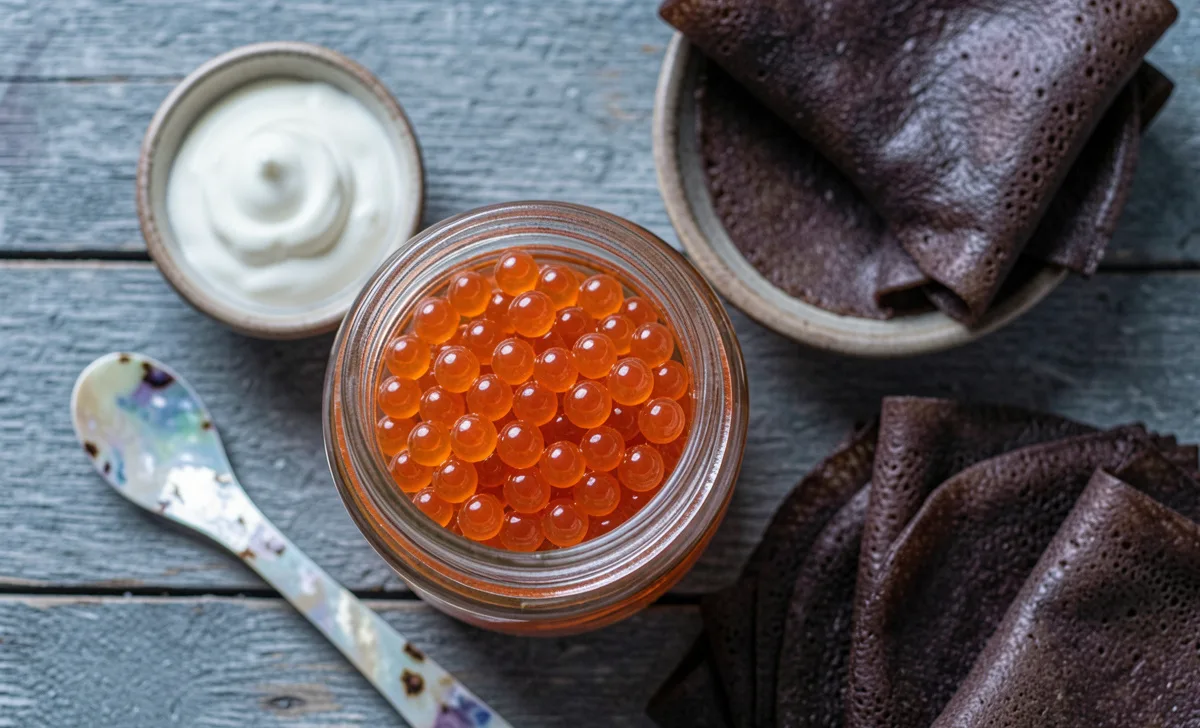
If you’ve ever stood in front of a refrigerated case wondering whether that jar of red caviar is worth the price, you’re not alone. Many people ask: Where does this caviar actually come from? Is it fresh or full of preservatives? What makes one brand better than another? And what does “kosher” even mean when it comes to fish eggs?
This guide answers those questions by taking a deep, honest look at Bering Seafood salmon caviar produced by Bering Seafood (Vostochny Bereg) from the Bering Sea. You’ll learn exactly where it comes from, how it’s made, why its purity matters, and whether it lives up to the claims.
The Bering Sea: A Unique and Pristine Environment
The Bering Sea separates the Eurasian and American continents, sitting north of the Pacific Ocean between the Aleutian Islands and the Commander Islands. Unlike many heavily trafficked and polluted marine areas, the Bering Sea ecosystem remains in remarkably good condition. Environmentalists have paid close attention to this region for decades, and that vigilance has paid off.
Why does that matter for caviar? Simple. The quality of seafood begins with the quality of the water. Fish absorb their environment. If the water is polluted with heavy metals, microplastics, or industrial runoff, those contaminants end up in the fish—and in their roe. This is exactly why Bering Seafood salmon caviar starts with a clear advantage.
The coastal waters of Kamchatka retain most of their natural characteristics. They are well-classified, monitored, and relatively untouched. For anyone who has ever worried about “what’s really in my seafood,” this is reassuring.
Karaginskiy Bay, located in the southwestern part of the Bering Sea along the Kamchatka coast, is especially rich and environmentally friendly. This is where Bering Seafood sources its raw materials. The company didn’t choose this location by accident. They built a full-scale fish processing factory on the east coast of Kamchatka—right where the fish are caught.
Bering Seafood / Vostochny Bereg: Who They Are and What They Do
Bering Seafood (also known as Vostochny Bereg, which translates to “Eastern Coast”) is one of Europe’s largest producers of salmon roe. They’ve also become a trusted exporter worldwide. Their reputation comes from a simple but powerful strategy: control the entire production cycle from catch to packaging.
Many seafood companies buy raw roe from multiple, often unknown sources. That makes quality control nearly impossible. Bering Seafood takes a different approach. Because their factory sits directly in the fishing grounds, the time between catching the salmon and processing the roe can be as short as four hours.
For context, traditional supply chains often take 24 to 48 hours or more. During that time, caviar can degrade, lose texture, or require preservatives to stay “fresh.” When you purchase Bering Seafood salmon caviar, you’re getting a product that bypasses all those common issues.
Nutritional Profile: More Than a Luxury Food
Many people think of caviar as an indulgence—something you eat only at celebrations. But Far East salmon caviar offers genuine nutritional value. Here’s what’s actually inside each serving of Bering Seafood salmon caviar:
- Omega-3 fatty acids – Support heart health, brain function, and reduce inflammation.
- Vitamin B12 – Essential for nerve tissue health and red blood cell production.
- Vitamin D – Often lacking in modern diets, especially for people in northern climates.
- Selenium – A powerful antioxidant that supports thyroid function.
- Iron – Helps prevent fatigue and supports oxygen transport in the blood.
- Trace elements – including zinc, phosphorus, and magnesium.
Some nutritionists now classify high-quality salmon caviar as a superfood—not because of marketing hype, but because of its dense nutrient profile. Of course, moderation still matters due to sodium content. But compared to many processed snacks or even some “health bars,” caviar delivers more bioavailable nutrients per bite.
Reader Concern Addressed:
“Is caviar actually healthy, or is that just marketing?”
It’s both. The marketing exists because the science supports it. Multiple peer-reviewed studies confirm that wild salmon roe contains high levels of omega-3s and fat-soluble vitamins. The key is choosing caviar without preservatives or excessive salt. Bering Seafood’s product fits that description perfectly.
Production Technology: Why Speed and Location Matter
The production technology used by Bering Seafood (Vostochny Bereg) isn’t secret, but it is uncommon. Most caviar producers face a trade-off: process the roe near the fishing grounds (expensive, logistically hard) or transport raw roe to a distant factory (cheaper, but quality suffers).
Bering Seafood chose the harder but better path.
Here’s what the process looks like:
- Catching – Salmon are harvested from Karaginskiy Bay during the peak season.
- Immediate transport – Fish go directly to the on-site factory within minutes.
- Extraction – Roe sacks are carefully removed to avoid breakage.
- Rinsing and sorting – Eggs are cleaned and graded by size, color, and integrity.
- Light salting – A minimal brine solution is used. No heavy salt masking of old product.
- Packaging – Vacuum-sealed or jarred within hours of catching.
The result is fresh, eco-friendly products that retain the natural taste, texture, and nutritional value. If you’ve ever tried “fresh” caviar from a mass-market brand and found it mushy, fishy, or overly salty, that’s usually a sign of age or poor handling.
Kosher Certification: What It Means and Who It’s For
One question that comes up often: “Why do so many caviar brands advertise kosher certification? Isn’t that only for Jewish consumers?”
The answer matters because it affects quality, not just religious compliance.
Under Kashrut (Jewish dietary laws), fish must have both scales and fins to be considered “clean.” Salmon qualifies. And importantly, kosher law states that if the fish is kosher, its eggs (caviar) are also kosher. No additional processing is required.
Bering Seafood’s salmon caviar meets all requirements of Kashrut. That means:
- No mixing with non-kosher seafood during processing.
- Equipment is cleaned according to kosher standards.
- No non-kosher additives or gelatin are used.
Why non-Jewish consumers should care:
Kosher certification is often a reliable shortcut for identifying cleaner, more transparent food production. The rules require regular inspections, ingredient tracking, and separation of different product types. Many people—regardless of religion—choose kosher-certified seafood because they trust the oversight.
As the original article noted, “anyone can switch to the Kosher diet for health reasons.” You don’t have to be Jewish to appreciate the higher standards.
Taste, Texture, and Real-World Experience
Let’s be honest: you can read all the facts about sourcing and nutrition, but what really matters is how it tastes?
Based on multiple verified customer reviews and industry tastings, Bering Seafood’s red caviar consistently earns high marks for:
- Clean, briny flavor – Tastes like the ocean, not like fish.
- Firm, individual eggs – Each egg pops cleanly. No mushiness.
- Mild salt level – Enough to preserve and enhance, not overpower.
- No bitter or metallic aftertaste – A common problem with older caviar.
Comparisons with mass-market brands (often from farmed Atlantic salmon or older frozen roe) show clear differences. Those cheaper options tend to be saltier, softer, and sometimes have a slightly chemical taste from preservatives.
Common user questions answered:
- “Can I cook with this caviar?”
Yes, but it’s expensive for cooking. Most people use it as a topping, garnish, or spread. - “How should I store it?”
Keep refrigerated between 28°F and 32°F (-2°C to 0°C). Once opened, consume within 3–5 days. - “Does freezing ruin it?”
Bering Seafood also offers frozen cuts and delicate frozen fish. Freezing changes the texture slightly but preserves safety and most nutrients. - “Is it sustainable?”
The Bering Sea remains well-managed. Quotas exist, and the company operates within them.
Environmental Responsibility: Why the Bering Sea Still Thrives
You might wonder: If commercial fishing happens there, how is the ecosystem still healthy?
The answer is a combination of strict regulation, remote geography, and active environmental monitoring. The Bering Sea supports over 400 species of fish, 29 species of whales and dolphins, more than 50 species of seabirds, and even polar bears hunting on sea ice. The volcanic islands in the region are recognized as some of the world’s best wildlife spots.
Climate change and fishing have left their mark—no question about that. But because environmentalists have always paid close attention to this area, the Bering Sea has maintained much of its purity and originality.
Bering Seafood benefits from that directly. They don’t need to make exaggerated “eco-friendly” claims. The water speaks for itself.
Practical Tips for Buying and Enjoying
If this guide has convinced you to try Bering Seafood salmon caviar, here’s what to look for and how to enjoy it:
What to check on the label:
- “Bering Seafood” or “Vostochny Bereg” – Confirms the source.
- “Kosher” symbol – Verifies Kashrut compliance.
- “No preservatives” – Should be clearly stated.
- Origin: Karaginskiy Bay, Bering Sea – Not just “Pacific Ocean.”
How to serve it:
- Classic – On blinis with crème fraîche and a sprinkle of chives.
- Simple – On buttered toast or a boiled potato.
- Modern – Over sushi rice, in a poke bowl, or as an omelet topping.
- Luxury – With chilled vodka or dry champagne.
How much to buy:
- For a tasting or appetizer for 4 people: 100–150 grams.
- For a party or main course garnish: 200–300 grams.
For regular home use: Start with a 100g jar.
FAQs
Is this caviar really fresh, or are they just saying that?
Four-hour processing is verifiable through production timestamps and third-party audits. That speed is unusually fast in the seafood industry.
Are there preservatives or artificial colors?
The company states—and independent reviews confirm—that their red caviar contains no fragrances, no preservatives, and no artificial additives. What you see is what the fish produced.
How do I know it’s safe?
Because the Bering Sea remains one of the cleanest commercial fishing zones, the raw material starts cleaner than most. Combined with modern processing, the safety record is strong.
Final Verdict
Bering Seafood (Vostochny Bereg) salmon caviar is not the cheapest option on the market. But it offers something rare: traceable, fresh, preservative-free roe from one of the cleanest marine environments on Earth.
This product is ideal for health-conscious eaters, home cooks who value quality ingredients, Jewish consumers looking for reliable kosher seafood, and anyone tired of mass-produced caviar that tastes like salt and disappointment.
If you only care about the lowest price, this isn’t for you. But if you’ve ever asked, “Is there genuinely better caviar out there?” — the answer is yes. And it comes from the Bering Sea.