
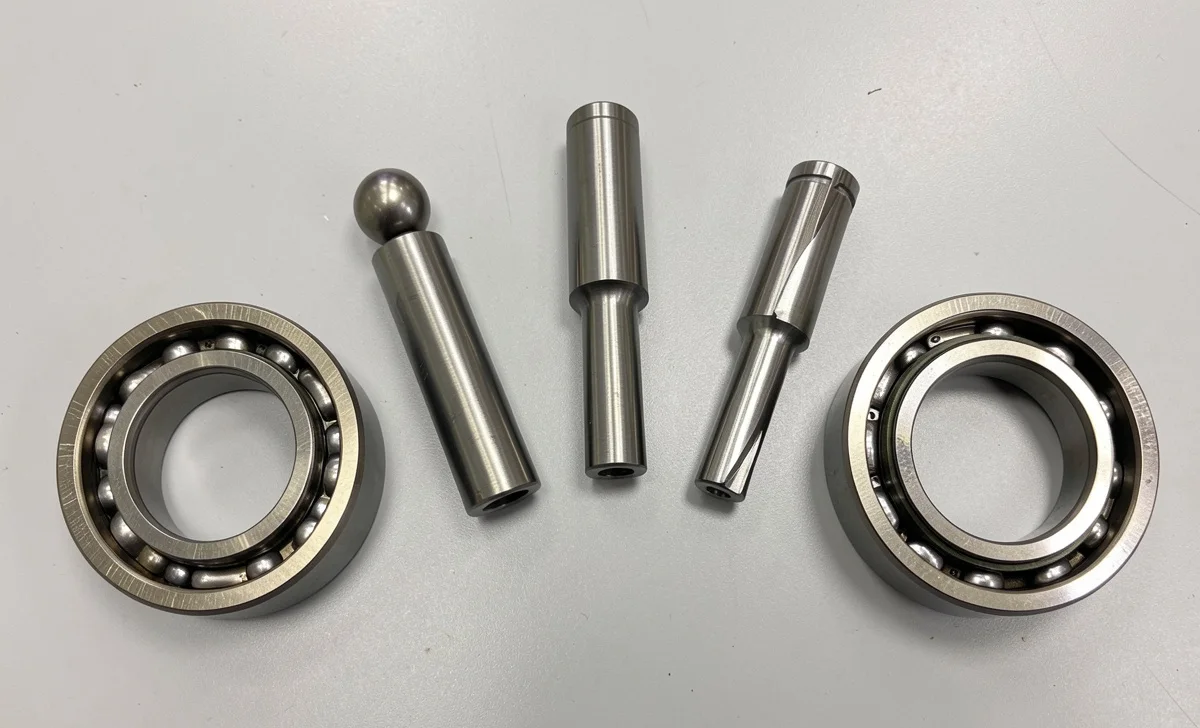
If you have ever driven a car, spun a wheel, or even used a ceiling fan — you have used a bearing. These small mechanical parts are everywhere. Yet most people have no idea which type they need until something goes wrong.
The problem is simple: there are many types of bearings, and choosing the wrong one leads to faster wear, mechanical failure, and wasted money. This guide breaks down every major bearing type in plain English and helps you pick the right one without confusion.
| Quick Answer
Bearings reduce friction between moving parts. To choose the right one, you need to know: the direction of the load (radial, axial, or both), the speed of rotation, and how much space you have to work with. Keep reading for the full breakdown. |
What Is a Bearing? (Simple Explanation)
A bearing is a mechanical device that supports a rotating or moving part and reduces friction between surfaces. Think of it as a go-between that allows one part to spin or slide smoothly against another.
Without bearings, metal would grind against metal — creating heat, friction, and rapid wear. Bearings solve this by introducing rolling elements (like balls or cylinders) or a smooth surface that makes movement easier and more efficient.
Two key concepts you need to understand before choosing a bearing:
- Radial load: A force that pushes perpendicular to the shaft (like the weight of a wheel pressing down on an axle).
- Axial load (thrust load): A force that pushes along the length of the shaft (like the pressure from a car’s steering thrust).
Most real-world applications involve one or both of these load types. That is what determines which bearing you need.
The Main Types of Bearings Explained
1. Ball Bearings
Ball bearings are the most common type. They use small metal balls sitting in a groove (called a raceway) between an inner and outer ring. The balls roll freely, reducing friction with minimal contact area.
They handle both radial and axial loads, but are best suited for lighter loads at high speeds. You will find them in electric motors, skateboards, hard drives, ceiling fans, and car alternators.
| Best for:
High-speed, light-to-moderate loads. Great for applications where both radial and axial forces exist but neither is extreme. |
2. Cylindrical Roller Bearings
Instead of balls, these use cylindrical rollers — think short, stubby cylinders. Because the roller makes a line of contact (rather than a single point like a ball), it can carry much heavier radial loads.
However, they do not handle axial loads well. You will find them in heavy machinery, conveyor systems, and industrial gearboxes where radial loads are the main concern.
| Best for:
Heavy radial loads where axial forces are minimal. Preferred in industrial and heavy-duty settings. |
3. Tapered Roller Bearings
These use cone-shaped rollers and tapered raceways. The geometry allows them to handle both heavy radial and axial loads simultaneously, making them extremely versatile.
You will find tapered roller bearings in car wheel hubs, truck axles, and transmissions. They are designed for demanding applications where loads come from multiple directions.
One thing to note: they usually come in pairs (mounted face-to-face or back-to-back) to balance the axial forces from each direction.
| Best for:
Combined radial and axial loads. The go-to choice for vehicle wheel bearings and heavy-duty axle applications. |
4. Thrust Bearings
Thrust bearings are designed specifically for axial (thrust) loads — forces that push along the shaft rather than across it. They are not suited for radial loads at all.
Common examples include automotive clutch mechanisms, propeller shafts, and helicopter rotor assemblies. You will also see them in vertical pump shafts where the weight of the shaft itself creates axial force.
| Best for:
Pure axial loads. If your application involves a shaft being pushed along its own axis, this is the bearing you need. |
5. Needle Roller Bearings
Needle bearings use very thin, elongated rollers (like needles). Their small diameter lets them fit into very tight spaces while still carrying substantial radial loads.
The trade-off: because they are so thin, they cannot handle axial loads well. They are commonly found in transmission shafts, rocker arm pivots, and two-stroke engine connecting rods.
| Best for:
Tight spaces with heavy radial loads. Perfect when radial load capacity is important but available space is very limited. |
6. Spherical Roller Bearings
These bearings have barrel-shaped rollers and a curved outer raceway, allowing them to self-align. That means even if the shaft tilts or bends slightly, the bearing still works correctly.
They are ideal for applications where shaft misalignment is expected — like heavy industrial equipment, mining machinery, or agricultural equipment that operates under vibration and uneven loads.
| Best for:
Applications with shaft misalignment, vibration, or both heavy radial and moderate axial loads. |
7. Plain Bearings (Sleeve Bearings)
Plain bearings — also called sleeve or journal bearings — do not use rolling elements at all. Instead, a smooth cylindrical surface (the sleeve) supports the shaft. They rely on a thin film of lubricant (oil or grease) to prevent metal-to-metal contact.
They are simple, inexpensive, and reliable at low speeds and steady loads. You will find them in car engine crankshafts, door hinges, and many household appliances.
| Best for:
Steady, low-speed, high-load applications where simplicity and quiet operation matter more than efficiency. |
Quick Comparison: Which Bearing for Which Job?
Use this table as a quick-reference guide when evaluating your options:
| Bearing Type | Best For | Load Type | Speed |
| Ball Bearing | Light loads, high speed | Radial + Axial | High |
| Roller Bearing | Heavy radial loads | Radial | Medium |
| Tapered Roller | Combined loads | Radial + Axial | Medium |
| Thrust Bearing | Axial loads only | Axial | Low-Medium |
| Needle Bearing | Tight spaces | Radial | Medium-High |
| Plain/Sleeve | Simple, low-speed apps | Radial | Low |
How to Choose the Right Bearing: A Step-by-Step Guide
Follow these steps and you will narrow down your options quickly.
Step 1: Identify Your Load Direction
Ask yourself: where is the force coming from?
- Force pushing across the shaft (sideways)? You need a radial bearing — ball, roller, or needle.
- Force pushing along the shaft (lengthwise)? You need a thrust bearing.
- Both directions? Go with tapered roller or spherical roller bearings.
Step 2: Consider Load Weight
How heavy is the load the bearing must support?
- Light load, high speed: ball bearings are the ideal choice.
- Heavy radial load: cylindrical roller or tapered roller bearings.
- Very heavy combined load with vibration: spherical roller bearings.
Step 3: Check the Operating Speed
Speed matters because some bearings handle high RPMs better than others. Ball bearings excel at high speeds. Roller bearings are better at moderate speeds. Plain bearings are preferred at low speeds under heavy loads.
Step 4: Measure Available Space
If space is tight, needle bearings are your friend. For standard spaces, ball or cylindrical roller bearings work well. If space is generous and loads are heavy, go with tapered or spherical rollers.
Step 5: Think About Misalignment and Vibration
Will the shaft bend, flex, or vibrate during operation? If yes, spherical roller bearings offer self-alignment and can compensate. For perfect shaft alignment, standard ball or roller bearings are fine.
Common Mistakes When Choosing Bearings
These errors trip up beginners and even experienced mechanics. Avoid them.
- Ignoring load direction: Using a radial bearing where axial load dominates will cause early failure. Always match the bearing to the load type first.
- Choosing based on price alone: Cheaper bearings often use softer steel and less precise tolerances. In a high-load application, this leads to failure faster than you expect.
- Skipping lubrication requirements: Some bearings come pre-sealed with grease. Others need regular oiling. Using the wrong lubricant — or none at all — dramatically shortens bearing life.
- Overlooking operating temperature: Bearings in high-heat environments need special materials or high-temperature grease. Standard bearings can fail quickly under extreme heat.
- Mixing up inner bore sizes: Always confirm the exact shaft diameter before ordering. A bearing that is even slightly too tight or loose will not work correctly.
Practical Tips for Beginners
New to bearings? These tips will save you time and money.
- Look at what came out. When replacing a worn bearing, photograph the old part and read the number stamped on it. That number tells you the exact size, type, and series you need.
- Buy from reputable brands. SKF, NSK, FAG (Schaeffler), and Timken are trusted names in bearing manufacturing. Avoid unbranded or counterfeit parts — especially for vehicle applications.
- Check for sealed vs. open bearings. Sealed bearings (with rubber or metal shields) are better for dirty or wet environments. Open bearings need regular lubrication but are easier to maintain.
- Do not force a bearing in by hammering on the outer ring. Always press or tap on the inner ring when installing. Hitting the outer ring transmits force through the balls, which damages the raceways.
- Match the preload if applicable. In wheel bearing sets (especially tapered rollers), correct preload is critical. Too tight and you create friction; too loose and you get play.
Frequently Asked Questions
What is the most common type of bearing used in cars?
Tapered roller bearings are most common in wheel hubs and drive axles due to their ability to handle combined radial and axial loads. Ball bearings are widely used in alternators, air conditioning compressors, and power steering pumps.
How do I know when a bearing is failing?
Common signs include a grinding or humming noise that changes with speed, vibration in the steering wheel or floorboard, uneven tire wear, and looseness when you rock the wheel side to side. Catching bearing failure early prevents more serious damage.
Can I replace any bearing with a ball bearing?
Not always. Ball bearings are versatile but have load limits. If you replace a tapered roller bearing in a wheel hub with a ball bearing of similar size, it will likely fail quickly because it cannot handle the same combined load. Always match the bearing type to the application.
What does the number printed on a bearing mean?
Bearing numbers follow international standards (like ISO or JIS). They encode the type, bore size, outer diameter, and width. For example, a number starting with 6 (like 6205) is a deep groove ball bearing. The last two digits multiplied by 5 give you the bore size in millimeters. When in doubt, use an online bearing catalog to look up the full specs.
Are ceramic bearings worth it for regular use?
Ceramic bearings (hybrid or full ceramic) are lighter, harder, and can handle higher speeds with less heat. They are popular in performance cycling and precision machinery. For everyday automotive or DIY use, standard steel bearings are more practical and significantly less expensive.
Conclusion: The Right Bearing Is the One That Fits Your Application
Bearings are not complicated once you understand what they do and what forces they are dealing with. The key questions to always ask are: What direction is the load? How heavy is it? How fast is the shaft spinning? How much space do I have?
Ball bearings cover most general-purpose and high-speed needs. Tapered roller bearings are the standard for vehicle wheel hubs and axles. Needle bearings solve tight-space problems. Thrust bearings handle axial-only forces. And when you need everything at once, spherical roller bearings have you covered.
Take a few extra minutes to identify these factors before purchasing. It will save you from early bearing failure, costly repairs, and the frustration of installing the wrong part twice.