
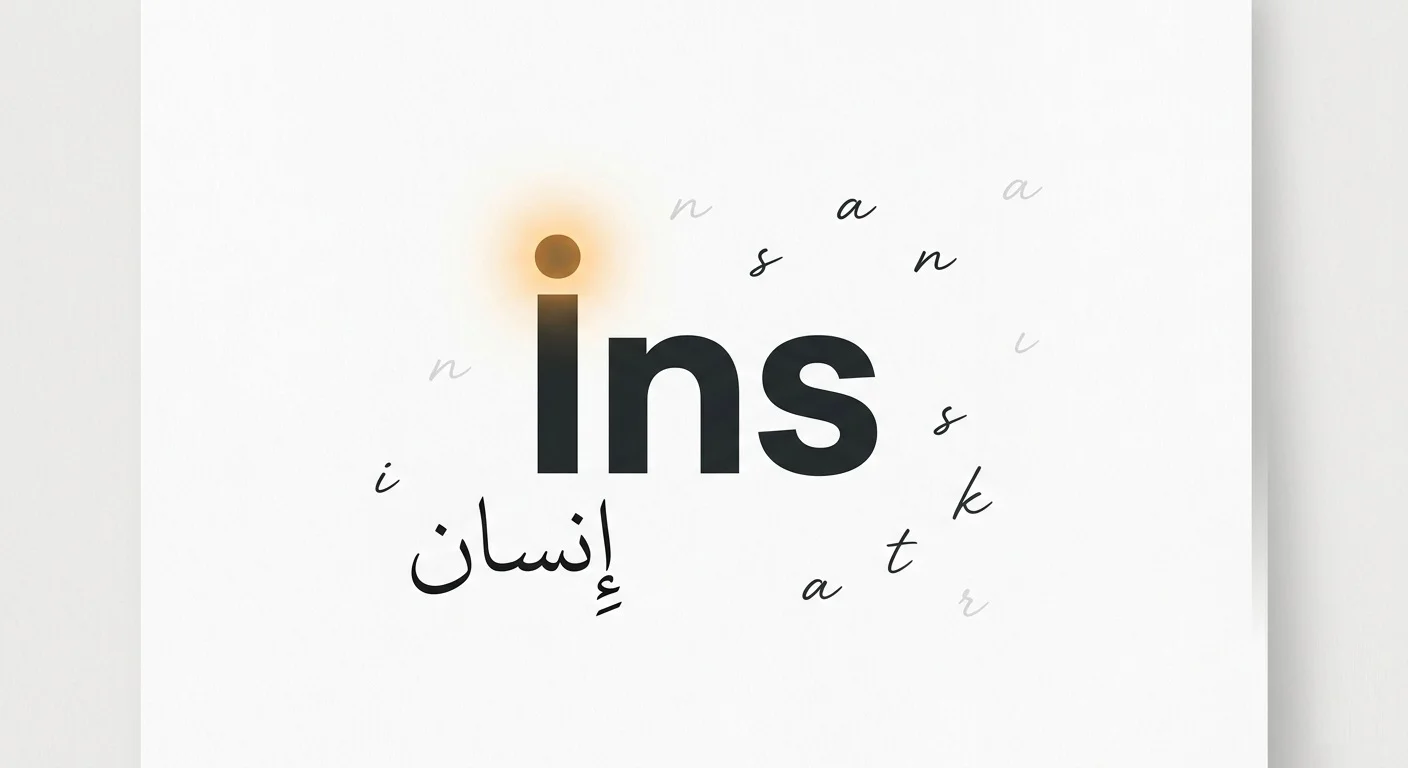
You spotted it in a bio. Maybe a caption. Perhaps a minimalist logo or a creator’s username. Three letters. One unusual dot.
İns.
It looks simple. It might even look like a spelling mistake. But it isn’t. İns carries a real meaning, a real cultural background, and an intention that many people find genuinely appealing. Once you understand it, you’ll start seeing it everywhere — and you’ll know exactly why it’s there.

What Does İns Actually Mean?
İns comes from insan — the word for human being used across Arabic, Turkish, Urdu, Persian, and several other languages.
Its deepest roots are Arabic. The word إنسان (insān) appears in the Quran and in classical Arabic literature. It traveled through Ottoman Turkish and became a standard word in modern Turkish as well. Today, insan is used across dozens of languages — from Urdu to Malay — all carrying the same core meaning: a human being.
When people shorten that to İns, they’re not losing the meaning. They’re distilling it. Three letters that quietly say: I am a person. A real one.
Is That Dot a Typo? The Dotted İ Explained
This is where most of the confusion starts.
In the Turkish alphabet, there are four versions of the letter “I” — not two like in English:
- İ / i — dotted, both upper and lowercase. Pronounced like the “ee” in “see.”
- I / ı — dotless, both upper and lowercase. A sound that doesn’t exist in English — a back vowel, roughly like a muffled “uh.”
The dotless I has the /ɯ/ sound, while the dotted İ has the /i/ sound. These are not stylistic choices. They are completely different letters with different sounds and different meanings.
The Turkish alphabet uses lowercase and uppercase forms of both dotted and dotless I. The dotted I, İ i, denotes the close front unrounded vowel sound (/i/). Both the upper and lower case versions have a dot.
In Unicode, U+0130 (İ) is capital I with dot. It is a distinct character — not a decoration, not a font trick.
So when someone writes İns with a dotted İ, that choice is deliberate. It signals the word’s linguistic roots. Dropping the dot and writing “ins” isn’t catastrophic in casual use, but it removes that cultural signal entirely.
The Arabic and Turkish Roots of Insan
Here is the fact that many articles get wrong: insan is not originally a Turkish word. It is Arabic in origin.
The Turkish word insan is inherited from Ottoman Turkish, which borrowed it from Arabic إِنْسَان (ʔinsān).
Insan is the Arabic and Persian word for “human” or “human being.” It appears across many languages influenced by Arabic, Persian, Urdu, Turkish, and Malay.
The Arabic root itself has two scholarly interpretations. Some scholars say the word comes from the Arabic root word anisa (انس), which means “to be companionable or friendly.” Other scholars say it comes from another Arabic root word nasiya (نسي), which means “to forget.” Both interpretations point to something deeply human — we are social beings, and we are forgetful ones.
Insan carries not just the literal meaning of “a person, member of the human species” but also ethical and philosophical shades — emphasizing humanity as distinct from animals or the divine.
This is the lineage behind İns. Not just a username trend — a word with centuries of meaning behind it.
İns vs. “Ins” — Not the Same Thing
It’s easy to confuse İns with the English word “ins” — as in the ins and outs of something. They’re genuinely different in both origin and meaning.
| İns | ins (English) | |
|---|---|---|
| Origin | Arabic → Turkish | Old English/Latin |
| Meaning | Human being | Plural of “in”; insiders |
| The dot | Intentional — linguistically significant | No dotted İ |
| Digital use | Identity marker, bio tag | Informal shorthand |
| Cultural depth | Centuries of philosophical history | Functional/contextual |
When someone uses İns in their profile, they almost certainly are not talking about “the ins and outs.” The dot makes the difference — and so does the context.
Why Do People Use İns on Social Media?
Here’s where linguistic history meets actual human behavior online.
It signals presence without performance. The word authentic has been used so often online that it means almost nothing now. İns sidesteps that problem. Because its root literally means human being, using it quietly communicates the same idea — without announcing it. Showing, not telling.
It has clean aesthetic appeal. İns is three characters. The dotted İ gives it an unexpected but balanced look. For creators who think carefully about how their profile appears — and many do — it reads as considered and intentional. Minimalist aesthetics have shaped creator culture across platforms for years. İns fits that naturally.
It creates soft community signals. When a symbol appears across multiple profiles in the same creative space, it becomes a low-key marker of shared values. People who use İns tend to value honest expression, cultural awareness, and simplicity over noise. Spotting it on someone’s profile can feel like recognizing a familiar way of thinking.
İns in Gen Z and Creator Culture
İns didn’t arrive through a viral moment or a paid campaign. It spread through creative communities — aesthetic content makers, digital artists, writers — people who tend to think carefully about the words and symbols they put on their profiles.
Gen Z has shown a consistent preference for communication that is short, layered, and visually considered. A word that looks calm, means something real, and connects to cultural history outside mainstream Western internet slang checks a lot of boxes for that audience.
There’s also a broader context here. Many young creators are actively resisting the pressure to perform or over-explain themselves online. İns, in that context, functions as a quiet placeholder for everything they don’t need to say out loud. I’m a person. That’s enough.
A Note on Cultural Respect
This matters, so it’s worth saying clearly.
İns traces back to Arabic, travels through Turkish, and carries meaning across Urdu, Persian, Malay, and more. The word insan appears in Islamic philosophical traditions as a term for the conscious, morally aware human being. That is a meaningful lineage.
Using İns in your digital identity doesn’t require you to be Arab, Turkish, or Muslim. But it does benefit from awareness. Knowing where a symbol comes from — and being honest about that when asked — is the difference between thoughtful appreciation and careless borrowing.
If someone asks you about it, being able to say “it comes from the Arabic word for human, insan, which is also used in Turkish, Urdu, and many other languages” is both accurate and respectful.
How to Type İ on Any Device
This question comes up more than you’d expect. Here’s a quick, practical guide:
iPhone / iPad: Long-press the “I” key. A popup shows accent options. Slide to İ.
Android: Long-press “I” on your keyboard for accent variations. Availability depends on your keyboard app.
Windows: Use Character Map, or simply copy-paste: İ
Mac: Go to Edit → Special Characters, or use the long-press method if your keyboard supports it.
Easiest option for regular use: Save İns in your phone’s text replacement shortcuts. Type a shortcut like “ins.” and it auto-corrects to İns.
How to Use İns Authentically
If İns resonates with you — if you like the meaning, the visual simplicity, or the cultural depth — here are some natural ways to use it:
In your bio: Place it near your name or at the end of a bio line as a soft tag. It works without needing explanation for those who know, and it invites curiosity for those who don’t.
In captions: Use it as a standalone word or closing mark in posts about presence, honesty, or self-expression.
In creative work: Writers, designers, and artists use İns as a signature, a project name, or a recurring motif — leaning into its meaning of human presence within creative output.
In branding: For small brands or apps built around human connection or mindful technology, İns has real naming appeal. It’s short, memorable, cross-culturally meaningful, and visually clean.
The Takeaway
İns is three letters rooted in one of the most universal ideas across human language and culture: what it means to be a person.
From Arabic scripture to Turkish everyday speech, from Urdu poetry to Gen Z creator bios — the word has traveled far and kept its meaning intact. In a digital space that often rewards performance over presence and noise over depth, choosing a symbol that traces back to the word for human is, quietly, a meaningful act.
Whether you use it in your bio, your brand, or simply carry the word with you — you now have the full picture.
Frequently Asked Questions
What does İns mean in English?
İns is a shortened form of insan, meaning “human being.” The word is originally Arabic (إنسان) and is widely used in Turkish, Urdu, Persian, and other languages. Online, it’s used as a quiet identity marker that signals authenticity and human presence.
Is İns a typo?
No. The dotted İ is a real, distinct letter in the Turkish alphabet with its own Unicode code point (U+0130). Writing İns with the dotted character is intentional and reflects the word’s linguistic roots.
Is insan a Turkish or Arabic word?
Both, in a sense — but the origin is Arabic. The word إنسان (insān) is Arabic, borrowed into Ottoman Turkish and then modern Turkish. It also exists in Urdu, Persian, Malay, and many other languages.
Why do people put İns in their social media bio?
It’s a minimalist way to say “I’m a real person who values honest expression.” It appeals to creators who prefer subtle, culturally aware identity markers over trend-driven labels.
Can anyone use İns?
Yes — but using it with awareness of its Arabic and Turkish roots makes the usage more intentional and more respectful. Understanding that it means human gives it meaning beyond decoration.
Now that you know what İns really means — how will you use it?
Add it to your bio, use it in your next caption, or simply keep the meaning close. A word that grounds you in your own humanity is always worth knowing.
We decode digital culture and internet language every week. Subscribe to stay ahead of what the internet is actually saying.