
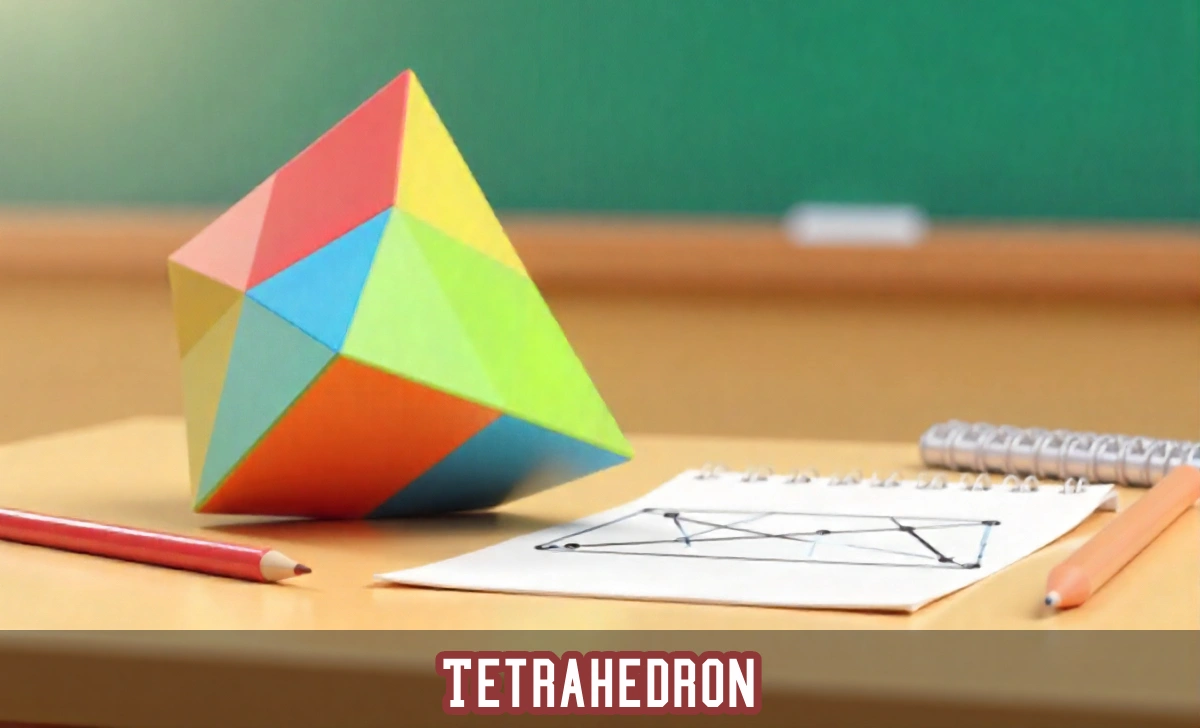
Have you ever looked at a pyramid and wondered about its simplest form? Or perhaps you’re a student staring at a geometry problem, trying to visualize a shape described as having “four triangular faces.” The tetrahedron, often overshadowed by cubes and spheres, is one of the most fundamental and elegant shapes in the entire world of geometry. It’s not just a mathematical abstraction; its perfect symmetry and structural strength appear in nature, from the arrangement of chemical bonds in a diamond to the shape of certain viruses. This guide is designed to take you from asking “What is a tetrahedron?” to understanding its properties, calculations, and types with the clarity of a seasoned tutor. Let’s build your understanding from the ground up.
What Exactly is a Tetrahedron? A Clear Definition
At its heart, a tetrahedron is the simplest possible polyhedron—a three-dimensional shape with flat polygonal faces. The name gives it away: “tetra” means four, and “hedron” means face. So, a tetrahedron is a 3D shape with exactly four faces.
Crucially, all four of these faces are triangles. This is why a tetrahedron is also commonly called a triangular pyramid. Think of a classic Egyptian pyramid (which has a square base and four triangular faces). Now, imagine making the base a triangle instead of a square. You’d have a pyramid with a triangular base and three triangular faces meeting at the top—that’s four triangular faces in total: a tetrahedron.


In formal terms, it’s defined as a convex polyhedron composed of four triangular faces, six straight edges, and four vertices (corner points). Every edge is where two triangles meet, and every vertex is where three triangles meet.
One of the most beautiful aspects of a tetrahedron is its symmetry. In its regular form, any of the four faces can be considered the base. It doesn’t have a “top” or “bottom” in the traditional sense. This perfect balance is what makes it so intriguing to mathematicians, scientists, and artists alike.
Foundational Properties: Faces, Edges, and Vertices
Let’s solidify the basics. When learning about any polyhedron, we describe it by its core building blocks:
- Faces: The flat polygonal surfaces. A tetrahedron has 4 faces (all triangles).
- Edges: The line segments where two faces meet. A tetrahedron has 6 edges.
- Vertices: The corner points where edges (and typically multiple faces) meet. A tetrahedron has 4 vertices.
You can remember this using the powerful Euler’s polyhedron formula: V – E + F = 2. For a tetrahedron: 4 (Vertices) – 6 (Edges) + 4 (Faces) = 2. It’s a perfect check!
A real-world analogy? Picture a simple, three-sided camping tent (a pup tent). The floor and the two sides are triangles, and if you imagine sealing the two triangular ends, you’ve essentially created a physical model of a tetrahedron. This highlights its property of being a closed, three-dimensional shape built entirely from triangles, making it inherently rigid—a principle used in truss bridges and architectural frameworks.
Not All Tetrahedrons Are Created Equal: Understanding the Types
This is where many geometry discussions get interesting. While we often picture a perfect, symmetrical tetrahedron, they come in different forms, each with unique properties.
- The Regular Tetrahedron: The Perfect Platonic Solid. This is the star of the show. A regular tetrahedron is one of the five Platonic solids—polyhedra with identical regular polygons for faces and the same number of faces meeting at each vertex.
- Faces: All four are congruent equilateral triangles (all sides and angles equal).
- Symmetry: It possesses the highest degree of symmetry. Every vertex, edge, and face is identical to the others.
- Real-World Example: The molecular structure of methane (CH₄) has a carbon atom at the center with four hydrogen atoms at the vertices of a regular tetrahedron.
- The Irregular Tetrahedron: The Asymmetric Cousin If a tetrahedron is not regular, it’s irregular. This simply means its faces are not all equilateral triangles.
- The base could be a scalene triangle (all sides different) or an isosceles triangle (two sides equal), with the other faces being different triangles.
- This is the most common “general” tetrahedron. The triangular pyramid in your geometry problem set, where sides are labeled with different lengths, is likely an irregular tetrahedron.
- The Right Tetrahedron: When Angles Matte.r A less commonly discussed but important type is the right tetrahedron. In this case, the three edges meeting at one vertex are mutually perpendicular to each other (like the corner of a box). It has a right-angled triangle as one of its faces. This type is particularly useful in vector geometry and 3D coordinate systems, as it fits neatly into the corner of a cube.
Visualizing the Shape: The Net of a Tetrahedron
How do you go from a flat piece of paper or cardboard to a 3D tetrahedron? The answer lies in its net. A net is a two-dimensional pattern that can be folded to form the surface of a 3D shape.
For a regular tetrahedron, the net is essentially four equilateral triangles connected along their edges. There are a couple of valid arrangements, often looking like a row of three triangles with a fourth attached to the middle one.
Key points for any net:
- It must contain all the faces of the shape.
- The faces must be connected in such a way that they can be folded along the edges to form the closed shape.
- Creating a physical model from a net is one of the best ways to truly internalize the structure of a tetrahedron. It answers the common student question: “How are these faces actually connected?”
Practical Geometry: Calculating Surface Area and Volume
Now for the practical application—the math you often need. Let’s break down the formulas in a clear, step-by-step manner.
Surface Area of a Tetrahedron: This is the total area covered by all four triangular faces.
- For a Regular Tetrahedron (with side length a): The area of one equilateral triangle is (√3/4) a². Therefore, the **Total Surface Area = √3 a²**. It’s beautifully simple.
- For an Irregular Tetrahedron: You must calculate the area of each of the four triangular faces individually (using formulas like ½ base height or Heron’s formula), and then add them all together. There’s no single shortcut, as every face can be different.
Volume of a Tetrahedron: The volume measures the 3D space it occupies. The universal formula, which works for any tetrahedron (regular or irregular) is: Volume = (1/3) × Base Area × Height
Here, the “Height” is the perpendicular distance from the vertex opposite the chosen base to the plane of that base. This is a critical point: you must use the perpendicular height, not the slant edge length.
- For a Regular Tetrahedron (side length a), the formula simplifies to: Volume = (a³) / (6√2)
- For a Right Tetrahedron with perpendicular edges of length u, v, and w meeting at the right-angled vertex, the volume is simply: Volume = (1/6) u v * w.
The Tetrahedron in Context and Common Questions
How is it different from other pyramids? A pyramid is defined by a polygonal base and triangular sides meeting at an apex. A tetrahedron is specifically a triangular pyramid. A square pyramid (like the Great Pyramid of Giza) has a square base and four triangular faces—five faces in total. The tetrahedron is the only pyramid that is also a polyhedron with the minimum number of faces.
Where do we see tetrahedrons in the real world? Beyond chemistry, they appear in:
- Nature: The silicates in many rocks form tetrahedral structures.
- Engineering: Tetrahedral trusses are incredibly strong and lightweight, used in space frames for roofs and bridges.
- Games & Design: Four-sided dice (d4) are regular tetrahedrons. The shape is also a staple in modern sculpture and design for its dynamic feel.
A Peek at a Complex Cousin: The Dodecahedron Just as you master the tetrahedron, you might encounter its more complex relative, the dodecahedron (another Platonic solid). While a tetrahedron has 4 faces, a dodecahedron has 12 pentagonal faces, 30 edges, and 20 vertices. It’s a fascinating study in contrast, highlighting the diversity within geometric concepts.
Conclusion: Why This Simple Shape Matters
Understanding the tetrahedron is more than memorizing a set of numbers and formulas. It’s about grasping a fundamental building block of three-dimensional space. From its perfect symmetry as a Platonic solid to its varied irregular forms, it teaches us about structure, stability, and spatial reasoning. Whether you’re calculating the volume of an irregular specimen in a geometry exam, designing a stable truss, or simply appreciating the geometry in a crystal, the principles of the tetrahedron serve as a sturdy foundation. By starting with this simplest of polyhedra, you build the spatial intuition needed to navigate the more complex shapes that make up our physical and mathematical world.