
A Snapshot of Current Market Fundamentals
 The Orange County industrial real estate market is a critical hub for businesses across Southern California. It is a dynamic sector, currently navigating a period of significant shifts and adjustments. Understanding these changes is essential for investors, tenants, and developers alike.
We will provide a clear overview of the current landscape. We will explore key metrics like vacancy rates and average asking rents, which show a market in transition.
We will also dive into the economic factors driving demand, such as port activity and e-commerce growth. Our analysis will cover major transactions and what they tell us about market trends.

Finally, we will offer an outlook for the near future, considering new construction and economic conditions. For a comprehensive look at the Orange County industrial real estate landscape, we invite you to explore further.
The Orange County industrial real estate market, a vital component of Southern California’s economic engine, is currently experiencing a period of normalization following the unprecedented demand surges of recent years. This normalization is characterized by a recalibration of key market indicators, offering both challenges and opportunities for stakeholders. Our analysis draws from recent reports, including those from JLL, Kidder Mathews, and Newmark, providing a multi-faceted view of this evolving landscape.
Vacancy and Rent Trends
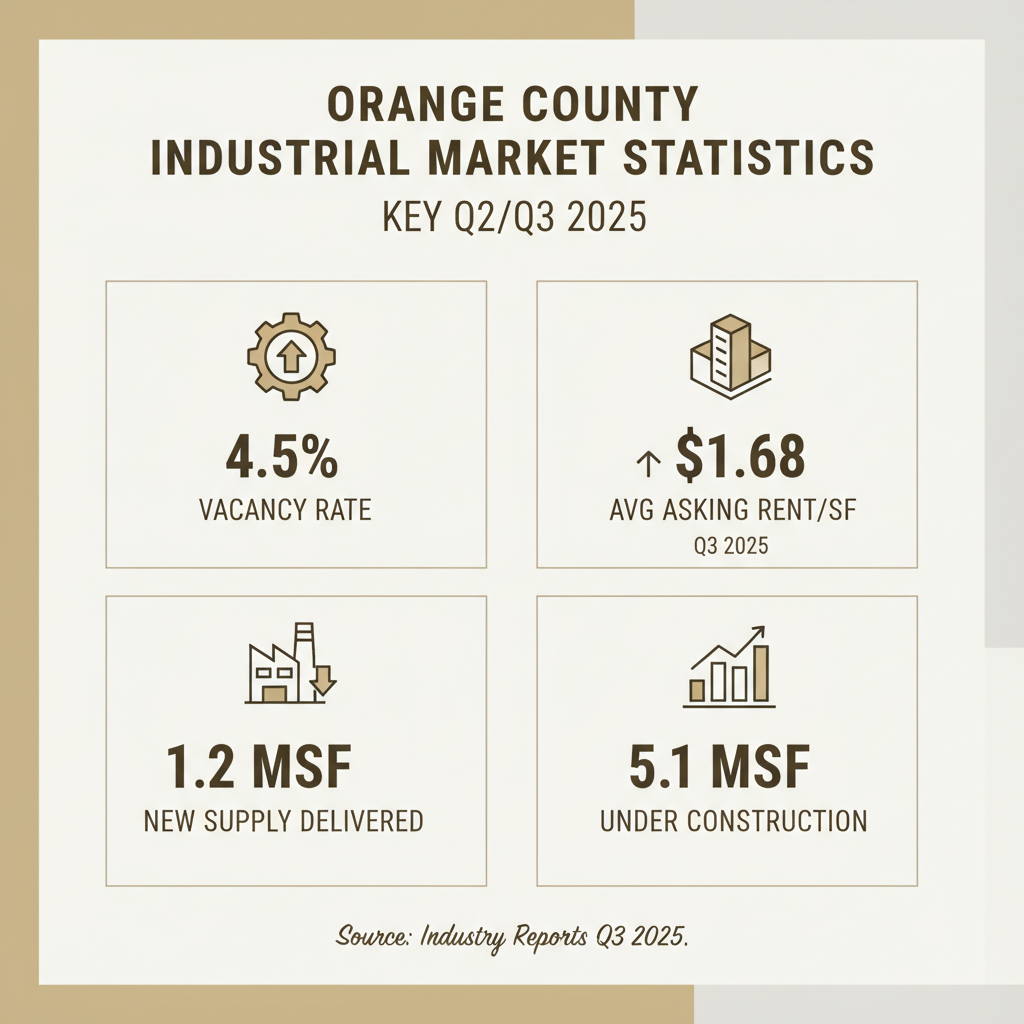
One of the most significant shifts in the Orange County industrial market has been the upward trend in vacancy rates and the corresponding adjustment in asking rents. According to Kidder Mathews’ Q3 2025 report, the direct vacancy rate increased to 5.5%, marking a rise from 5.2% in Q2 and 4.0% year-over-year. Newmark’s 2Q25 report notes a similar trend, placing the vacancy at 5.0%, which is 260 basis points higher than two years prior. While these figures represent an increase from the record lows of 1.8% at the end of 2022 (Lee & Associates Q4 2023), they remain historically tight, particularly when compared to the 2010 peak of 6.7% during the Global Financial Crisis. Avison Young’s Q1 2025 report indicated an even higher vacancy rate of 7.9% as new construction approached delivery, suggesting a dynamic and varying landscape across different reporting periods and submarkets.
This increase in available space has naturally led to a softening of lease rates. The average asking rent dropped to $1.49 per square foot (PSF) NNN in Q3 2025, a 6.3% decrease year-over-year, as reported by Kidder Mathews. Newmark’s 2Q25 data shows asking rents at $1.54/SF NNN, down from an all-time high of $1.65/SF NNN two years ago. This adjustment is a clear indicator that the frenzied pace of rent growth seen in 2021 and 2022, which saw countywide rent growth reach 18.2% in 2022, has decelerated significantly, falling to 9.6% year-over-year in 2023 (Lee & Associates Q4 2023).
In response to these changing market conditions, landlords are adapting their strategies. Avison Young noted that some landlords have lowered rents to $1.56/SF, while Lee & Associates observed that some resumed offering rent concessions to credit tenants in 2023. Kidder Mathews further suggests that landlords are now offering a more balanced mix of space for both lease and sale, reflecting a more competitive environment. This shift presents a strategic advantage for tenants, who now have more leverage and opportunities to secure favorable terms. Understanding the nuances of these lease structures, such as solveing the mysteries of Triple Net Leases (NNN) in Orange County, becomes even more critical in this environment.
Absorption and Leasing Velocity
The demand side of the equation also tells a story of transition. Net absorption, a key metric indicating the total amount of space occupied versus vacated, has shown a mixed but improving picture. Kidder Mathews reported negative net absorption of -202K SF in Q3 2025, signaling continued tenant turnover. However, Newmark’s 2Q25 report offered a more optimistic view, noting that net absorption turned positive for the first time in ten quarters, reaching 81,171 SF. This divergence highlights the quarter-to-quarter volatility and the gradual nature of market adjustments. For the full year 2023, Lee & Associates reported a significant 1.6 million SF of negative net absorption, the most in 14 years, underscoring the extent of the market’s recalibration.
Despite some negative absorption figures, leasing activity has shown signs of a rebound. Kidder Mathews’ Q3 2025 report indicated that total leasing volume reached 1.37 million SF, driven by notable demand for sub-20K SF buildings. Newmark’s 2Q25 data echoed this sentiment, stating that leasing activity increased to its highest level in three years. This rebound suggests that while larger tenants may be exercising caution, smaller and mid-sized businesses are actively seeking space. A significant driver behind this activity is that with softening lease rates, many tenants are now seriously considering relocation over renewal, seeking more advantageous terms or better-suited facilities. For businesses navigating these choices, a comprehensive guide to decoding the industrial lease can be an invaluable resource.
Economic Drivers Shaping Industrial Demand
The Orange County industrial real estate market does not operate in a vacuum; it is deeply influenced by broader economic forces, both global and local. From the ebb and flow of international trade to the spending habits of consumers and the health of local industries, these factors collectively dictate the demand for warehouse, distribution, and manufacturing spaces.
The Influence of Trade and E-Commerce
Orange County’s strategic location, serving as a mid-point between Southern California’s ports, airports, and the San Diego metro area, makes it highly sensitive to port activity. The Ports of Los Angeles and Long Beach, consistently among the busiest in the world, are critical arteries for goods flowing into the U.S. According to Newmark’s 2Q25 report, Southern California’s ports experienced their second busiest year on record in 2024, with loaded import volume in the first five months of 2025 ranking as the third highest on record. This high volume of imports typically correlates strongly with increased demand for industrial warehousing and distribution space in the region. However, Kidder Mathews’ Q3 2025 report noted that reduced port activity in some periods has lowered demand for logistics-related space, highlighting the fluctuating nature of global supply chains and their immediate impact on local real estate.
Beyond traditional trade, the relentless growth of e-commerce continues to be a foundational driver for industrial demand. The need for efficient last-mile delivery and robust distribution networks fuels the requirement for strategically located warehouses and fulfillment centers. Newmark’s 2Q25 data indicates that U.S. consumer e-commerce sales annual growth stood at 7.6% in Q1 2025, demonstrating sustained expansion in this sector. This consistent growth means that businesses are constantly evaluating how to evaluate warehouse locations for your business to meet evolving delivery expectations. The ability to quickly and efficiently move goods from port to consumer remains paramount, making Orange County’s connectivity a significant asset.
Orange County’s Unique Economic Profile
Orange County boasts a robust and diverse economy that provides a strong underpinning for its industrial real estate sector. With a population of 3,294,380, it represents a substantial consumer base. Notably, Orange County’s median household income is the highest in Southern California, as highlighted by Newmark’s 2Q25 report. This affluent population translates into strong consumer spending, which in turn drives demand for goods and the industrial space required to store and distribute them.
The county’s diverse job market further contributes to its economic resilience. Key sectors such as advanced manufacturing, healthcare, and life sciences create a steady and specialized demand for industrial properties, ranging from specialized manufacturing facilities to R&D spaces. However, the employment landscape within these industrial-using sectors has seen some shifts. Newmark’s 2Q25 report indicates that local industrial-using employment has declined year-over-year since March 2024, primarily due to a spate of plant closures and a continued decline in manufacturing employment over the last 12 months. Despite these specific sectoral contractions, the overall local unemployment rate dropped to 3.6% in May, suggesting a generally healthy labor market that can support industrial operations, albeit with ongoing challenges in finding qualified workers for specific roles. The distinction between manufacturing facilities vs. warehouses becomes relevant here, as different industries have distinct property needs.
Leasing and Sales in the Orange County Industrial Real Estate Market
The Orange County industrial real estate market, despite its recent recalibration, remains a highly active arena for both leasing and sales. Recent transactions provide valuable insights into prevailing market trends, investor sentiment, and tenant strategies.

Prevailing Trends in Industrial Property Sales
The sales market in Orange County has shown a dynamic picture, influenced by economic conditions and investor confidence. According to Kidder Mathews’ Q3 2025 report, the average sale price was $350.94 PSF, with a cap rate of 6.4%. Avison Young’s Q1 2025 data noted an average price of $333/SF, with Q1 2025 sales reaching $333 million, a substantial increase in activity compared to the previous quarter. Newmark’s 2Q25 report provided a broader perspective, stating that industrial sales volume totaled $1.3 billion in the first half of 2025, marking a significant 38.2% increase from the same period in 2024. Industrial properties comprised 33.7% of the total sales volume year-to-date, indicating their continued attractiveness to investors.
Buyer activity is diverse, with both private and institutional investors remaining active in the market. A notable trend is the strong performance of owner-user acquisitions, where businesses purchase properties for their own operational needs rather than for investment purposes. Newmark’s 2Q25 report highlighted two such significant owner-user investments: Jiaherb acquiring a 130,925 SF property in Brea for $53.7 million, and the Lake Forest Reliability Project purchasing 102,299 SF for $50.9 million. These transactions underscore a desire among companies to control their real estate costs and secure long-term operational stability. Another significant property trade noted by Lee & Associates’ Q4 2023 report was the sale of a 21-acre site at 1683 Sunflower Ave. in Costa Mesa for $72 million, indicating continued interest in larger development parcels. For those considering such acquisitions, understanding the industrial real estate due diligence checklist is paramount.
Notable Leasing Activity and Tenant Behavior
Leasing activity has seen a robust rebound in recent quarters, signaling a renewed confidence among businesses in Orange County. Kidder Mathews’ Q3 2025 report noted a total leasing volume of 1.37 million SF, with a particular uptick in demand for buildings under 20,000 SF. Newmark’s 2Q25 report further emphasized this resurgence, stating that leasing activity increased to its highest level in three years. A significant trend observed by Newmark is the substantial jump in Class A leasing activity during the first half of 2025, indicating a preference for modern, high-quality facilities.
Several significant lease transactions highlight the diverse tenant base and ongoing demand. Lee & Associates’ Q4 2023 report identified the largest direct lease in that quarter as a 167,778 SF building at 5800 Skylab Road in Huntington Beach. More recently, Newmark’s 2Q25 report showcased two major deals: Bio-Rad Laboratories signed for 283,130 SF (a renewal and expansion), and Taylor Fresh Foods signed a new lease in Anaheim for 207,074 SF. These transactions demonstrate that large-scale users, particularly in life sciences and food distribution, continue to seek substantial footprints in the region.
Tenant behavior is also evolving. Avison Young’s reports suggest that occupiers are shifting their focus from aggressive expansion to consolidation and efficiency, driven by reduced consumer demand. This means businesses are scrutinizing their existing footprints, potentially downsizing excess space, or seeking more optimized layouts. The softening lease rates also empower tenants to consider relocation over renewal, actively seeking more favorable terms or properties that better suit their operational needs, such as warehouses with high ceilings for improved storage capacity.
A Guide to Key Industrial Submarkets
Orange County’s industrial landscape is not monolithic; it is a mosaic of diverse submarkets, each with unique characteristics, performance metrics, and appeal to different types of industrial users. Understanding these distinctions is crucial for anyone looking to invest in or lease industrial property within the county.

Exploring Properties in the Orange County Industrial Real Estate Market
The types of industrial properties available in Orange County are as varied as the businesses that occupy them. We see a robust mix including traditional warehouses, which are essential for storage and logistics; specialized distribution centers designed for high-volume throughput; manufacturing facilities catering to the county’s advanced manufacturing sector; and flex spaces that offer a blend of office and industrial use, often favored by R&D companies. For a deeper dive into these various categories, our guide on industrial building types explained provides comprehensive insights.
In terms of size, the market caters to a wide spectrum of needs. Newmark’s 2Q25 report indicates that the average direct listing size is 5,492 SF, with 50% of available direct space found in suites smaller than 9,000 SF. This suggests a strong supply of smaller, more accessible units suitable for local businesses or startups. Conversely, the sublease market often presents larger options, with an average listing size of 11,054 SF and 50% of available sublease space in suites 20,000 SF or larger, reflecting businesses consolidating or shedding excess capacity. These larger spaces are often crucial for operations requiring significant storage or complex logistics, where mastering truck access is a key consideration.
Orange County’s industrial properties are spread across various cities, each offering distinct advantages. For instance, you can find industrial properties for sale in Anaheim, CA, Buena Park, CA, Costa Mesa, CA, Fullerton, CA, Irvine, CA, Placentia, CA, and San Clemente, CA. Each of these locations offers different access points to major transportation routes, labor pools, and customer bases.
Submarket Performance Overview
The performance of Orange County’s industrial market varies significantly by submarket. Lee & Associates’ Q4 2023 report provides a detailed breakdown:
- North County: As the largest submarket, encompassing 117.3 million SF, North County plays a pivotal role in the county’s industrial landscape. It has seen considerable activity but also holds a substantial portion of the market’s available sublease space, as noted by Newmark’s 2Q25 report. This may indicate some businesses in this dense area are optimizing their footprints.
- South County: This submarket experienced a contraction of 685,850 SF over four quarters in 2023, with its vacancy rate increasing from 2.4% to 4.4%. This shift suggests a more pronounced adjustment in demand compared to other areas.
- Airport Area: Historically a strong submarket due to its proximity to John Wayne Airport, the Airport Area reported negative net absorption of 278,173 SF for the year in 2023. This could be influenced by specific tenant movements or a pause in expansion plans.
- West County: This submarket demonstrated relative strength in Q4 2023, posting 386,018 SF of net absorption, while its vacancy rate settled at 4.5%. This performance indicates targeted demand in certain areas within West County.
These submarket differences highlight the importance of localized analysis. While the overall county trends provide a macro-level view, specific investment or leasing decisions benefit from a granular understanding of each submarket’s unique dynamics, including factors like available infrastructure, labor force, and zoning regulations. For example, businesses seeking flex space in industrial real estate might find different opportunities in North County compared to South County.
Future Outlook: What’s Next for OC Industrial?
The Orange County industrial real estate market is ready for continued evolution, with several factors shaping its trajectory in the near future. The interplay of new construction, prevailing economic conditions, and interest rate movements will dictate the market’s path toward stability and potential growth.

New Construction and Its Impact
New construction activity, while still present, has adopted a more cautious approach compared to the speculative boom of previous years. Kidder Mathews’ Q3 2025 report indicated that 525K SF of new industrial space was delivered in that quarter, contributing to the overall inventory. However, Newmark’s 2Q25 report highlighted a significant drop in under-construction activity, down to 1.8 million SF across 11 development projects. A key challenge for these new developments is the limited pre-leasing activity; Avison Young’s Q1 2025 report noted that 85% of new construction approaching delivery was still unleased.
This lack of pre-leasing, combined with the delivery of new, unabsorbed space, is expected to exert upward pressure on vacancy rates in the coming quarters. Newmark explicitly states that vacancy will increase as some tenants enact cost-cutting measures and new speculative construction delivers vacant. However, Kidder Mathews offers a more nuanced view, suggesting that new development activity has been “checked,” preventing an oversupply of inventory. This cautious approach by developers, coupled with high barriers to entry in Orange County, could ultimately contribute to market stability by preventing a massive glut of space. The quality and features of these new developments, such as specific dock doors vs. drive-in doors, will be critical in attracting tenants.
Projections for 2025 and Beyond
Looking ahead, most industry experts anticipate a period of stabilization, followed by a potential rebound for the Orange County industrial market. Kidder Mathews’ Q3 2025 report projects that the market will begin to rebound in the coming months, with lease rates stabilizing and potentially trending upward. A significant contributing factor to this optimistic outlook is the expectation that interest rates will adjust downward, easing decision-making pressure for both investors and businesses. This could stimulate renewed transaction activity and contribute to an upward trajectory in property values.
However, the path forward is not without its challenges. Newmark’s 2Q25 report cautions that sales activity is expected to fluctuate as investors contend with the current economic climate, and businesses may continue to adopt a “wait-and-see” approach during periods of volatility, which could dampen near-term leasing activity. Despite these headwinds, Orange County’s fundamental strengths – its affluent population, diverse economy, and strategic location – are expected to provide a resilient foundation. The market’s relatively smaller inventory compared to neighboring regions like the Inland Empire, combined with its high-earning consumer base, is projected to result in slower rent declines than those experienced elsewhere. As businesses continue to fine-tune their operations, identifying the warehouse sizing sweet spot will be crucial for efficiency and cost control.
Frequently Asked Questions about Orange County Industrial Real Estate
What is the current vacancy rate for industrial properties in Orange County?
The direct vacancy rate for industrial properties in Orange County has recently seen an increase, hovering around 5.0% to 5.5% in Q2 and Q3 2025, according to reports from Newmark and Kidder Mathews. While this is an uptick from the record lows of 1.8% seen at the end of 2022, it remains historically tight and below peaks seen during past economic downturns. Some reports, like Avison Young’s Q1 2025, show higher figures closer to 7.9% as new construction comes online.
Are industrial rents in Orange County going up or down?
Average asking rents in Orange County have recently declined from their all-time highs. Kidder Mathews reported an average asking rent of $1.49 PSF NNN in Q3 2025, a 6.3% decrease year-over-year. Newmark’s 2Q25 report indicated rents at $1.54/SF NNN, down from previous peaks. This softening has led some landlords to offer concessions, providing opportunities for tenants. However, experts anticipate rates will stabilize in the near future due to the market’s strong fundamentals and limited new supply.
What types of businesses are driving demand for industrial space in Orange County?
Demand for industrial space in Orange County is diverse, coming from various sectors. While traditional logistics and distribution tenants remain active, there is significant leasing from life science companies like Bio-Rad Laboratories (283,130 SF renewal/expansion), food producers such as Taylor Fresh Foods (207,074 SF new lease), and advanced manufacturing and defense contractors. There is also strong demand for smaller spaces (under 20,000 SF) from a wide range of local businesses, reflecting Orange County’s affluent population and diverse economic base in sectors like healthcare and technology.
Conclusion
The Orange County industrial real estate market is currently navigating a period of normalization, characterized by adjusting vacancy rates and softening rents after years of unprecedented growth. While we observe a slight increase in available space and a more cautious approach to new construction, the market’s underlying fundamentals remain robust. The county’s strategic location, its affluent population, and diverse economic sectors, including advanced manufacturing and life sciences, continue to drive resilient demand.
Leasing activity has shown signs of a rebound, particularly for smaller spaces, and the sales market remains active with significant owner-user acquisitions. Landlords are adapting by offering more flexible terms and a balanced mix of available properties. Looking ahead, the outlook suggests a potential stabilization of lease rates and a rebound in transaction activity, especially as interest rates are expected to adjust downward. Despite some short-term challenges, Orange County’s industrial sector is well-positioned for future stability and sustained appeal, making it a dynamic and attractive market for businesses and investors alike.