
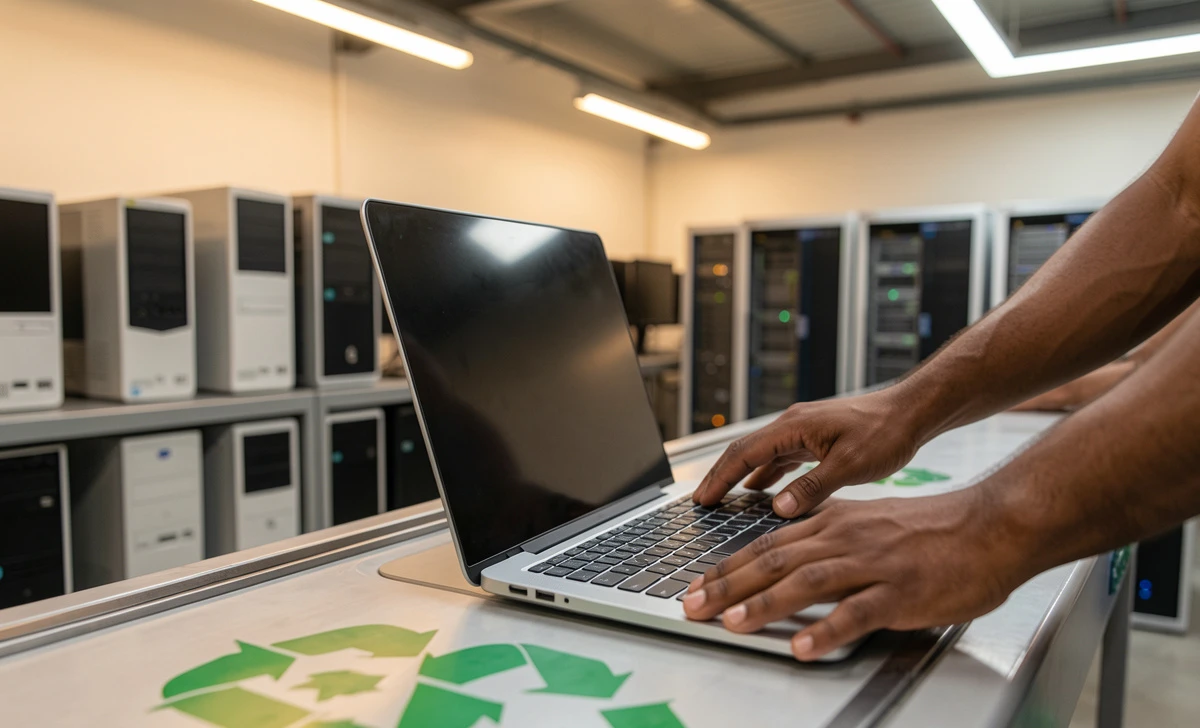
Did you know that the average data breach now costs companies a staggering $4.44 million? Or that the world generates over 62 million metric tons of e-waste annually—enough to fill over 1.5 million transport trucks?
For most of us, an old laptop stuffed in a drawer doesn’t look like a liability or an environmental hazard. It just looks like last year’s model. But with only about 12.5% of electronic waste formally recycled, the rest piles up in closets or, worse, ends up in landfills where it leaks toxins into the soil.
Bringing your old devices to a certified computer recycling center isn’t just about being “green.” It’s about protecting your identity, reclaiming your space, and even putting a little cash back in your pocket. Here are the five benefits of recycling your old technology the right way.


Reclaim Your Space and Declutter Your Life
If you’re like most people, you have a “tech drawer”—that black hole in your kitchen or home office where dead smartphones, broken printers, and obsolete cables go to die. These heaps of electronics don’t just look messy; they actively steal square footage from your living area.
Electronic recycling provides an immediate solution to this modern clutter problem. By arranging a pickup or drop-off with a local recycler, you can instantly free up cabinets and drawers for items you actually use. There is a tangible sense of relief that comes with clearing out the physical remnants of outdated technology. It transforms your home office from a storage unit back into a functional workspace.
Bridge the Digital Divide Through Donation
Here is a reality check: that five-year-old laptop you think is useless might be a lifeline for someone else. While it may struggle to run the latest video games, it is likely more than capable of handling word processing, video calls, and web browsing.
Many responsible recycling centers partner with non-profit organizations to refurbish working electronics. For example, programs like Compudopt take donated laptops and desktops, refurbish them, and distribute them to students, families, and underserved communities. To date, such initiatives have distributed over 111,000 computers and helped connect thousands of households to essential digital resources.
By choosing a recycler that prioritizes reuse over shredding, your electronic waste becomes a tool for online schooling, job applications, and digital literacy. You aren’t just throwing away a computer; you are handing someone else an opportunity.
Conserve Finite Resources and Energy
We often think of recycling in terms of keeping stuff out of landfills, but the bigger picture is about what we keep in the ground. The manufacturing of electronics requires mining for finite resources like gold, silver, copper, aluminum, and palladium.
When you recycle a circuit board, you are effectively “urban mining.” You are providing manufacturers with secondary raw materials that require significantly less energy to process than virgin ore. The environmental savings are massive. Recycling one million laptops saves the energy equivalent to the electricity used by over 3,500 U.S. homes in a year. On a larger scale, reclaiming materials like steel and plastic from e-waste reduces the need for destructive mining operations, preserving natural landscapes and reducing water pollution.
Furthermore, scientific studies confirm that reuse is even better than recycling. Extending the life of IT equipment like laptops and PCs can cut greenhouse gas emissions by up to 31% compared to manufacturing new ones, because the energy required to mine and produce new materials is avoided entirely.
Unlock Hidden Financial Value
Many people are surprised to learn that their old computer contains trace amounts of precious metals. While you aren’t going to retire on the proceeds of a single motherboard, recyclers can extract value from these materials.
Moreover, if your device is still in decent shape, you aren’t limited to just recycling it for free. Many IT asset disposition (ITAD) companies and recyclers offer revenue-sharing or buyback programs for bulk equipment. Even if the cash offer is minimal, the fact that you are disposing of it responsibly is a value in itself, as it saves you the “hidden cost” of doing nothing—namely, the depreciation of the asset sitting in a closet doing nothing for you.
Guarantee Data Safety and Secure Destruction
This is arguably the most critical benefit. Simply deleting your files or reformatting the hard drive is not enough to protect your privacy. Standard deletion only removes the pointers to the data, leaving the actual information recoverable with simple software tools.
Certified computer recycling centers address this risk with professional data sanitization. They adhere to strict standards like NIST 800-88, which outlines how to securely clear, purge, or destroy data. They use methods such as:
- Secure Wiping: Overwriting the hard drive multiple times with randomized patterns to make original data irretrievable.
- Degaussing: Using a powerful magnetic field to disrupt the magnetic domains on a hard drive, effectively scrambling the data.
- Physical Destruction: Shredding or crushing the hard drive into tiny pieces.
A reputable recycler will provide you with a Certificate of Data Destruction, offering a documented chain of custody that proves your sensitive information—whether banking details, client lists, or family photos—has been permanently destroyed. This is essential for businesses needing to comply with regulations like GDPR or HIPAA.
Choosing a Computer Recycling Center: What to Look For
Not all recycling companies operate ethically. Alarmingly, estimates suggest that 70-80% of the e-waste “recycled” in the U.S. is shipped to developing countries, where it is often processed by workers—sometimes children—in unsafe conditions, breathing toxic fumes to extract valuable metals.
To ensure your electronics are handled responsibly, you need to vet your recycler. Here are the key certifications to look for, which act as your assurance of quality and ethics:
R2 (Responsible Recycling) Certification
R2 is one of the most widely recognized standards globally. It focuses on environmental, health, safety, and data security protocols. R2v3, the latest version, prioritizes reuse and requires rigorous auditing to ensure that recyclers aren’t just dumping waste illegally.
e-Stewards Certification
Developed by the Basel Action Network (BAN), e-Stewards is considered the “gold standard” for global responsibility. It goes a step further than R2 by strictly prohibiting the export of hazardous e-waste to developing countries. e-Stewards recyclers are required to track waste streams via GPS to ensure compliance.
NAID AAA Certification
If you are concerned about data security, look for NAID AAA certification. This specifically verifies that the recycler’s data destruction processes meet the highest industry standards and are subject to scheduled and unannounced audits by security professionals.
ISO 14001 & 45001
- ISO 14001 indicates the company has an effective environmental management system, minimizing its operational footprint.
- ISO 45001 focuses on occupational health and safety, ensuring that the workers dismantling your electronics are doing so in a safe environment.
Don’t be afraid to ask questions. A trustworthy recycler will be transparent about their downstream vendors and will happily provide you with their certification credentials and certificates of destruction. If they can’t or won’t tell you where your e-waste ends up, that is a major red flag.
Conclusion
Taking your old computer to a recycling center is a small errand with massive ripple effects. It clears your home, protects your privacy, supports global sustainability, and can even help bridge the digital divide. By taking a few minutes to find a certified R2 or e-Stewards recycler, you ensure your outdated tech has a second life—not a second life as pollution, but as a resource for the future.