
The Role of Serial Interfaces in Industrial Measurement

Two communication standards, current loop and RS-232, have historically played key roles in these settings. While both facilitate serial data exchange, they operate on different principles. Their distinct characteristics mean that direct connection between them is not possible.
This creates a need for conversion between current loop and RS-232 interfaces. Understanding this conversion is vital for integrating legacy systems with newer equipment, or for optimizing data flow in challenging conditions. For comprehensive insights into industrial communication and control, many professionals turn to specialized providers of Industrial Measurement Solutions.


This guide will explore the essentials of current loop to RS-232 conversion. It will delve into what these interfaces are, why conversion is necessary, and what to look for in a converter. We will also cover different types, wiring configurations, and practical applications to ensure seamless industrial communication.
Serial communication interfaces are fundamental to industrial measurement and control systems. They enable devices to exchange data bit by bit over a single line, minimizing wiring complexity. In industrial settings, these interfaces are often challenged by harsh conditions, including significant electrical noise, ground loops, and the need for data transmission over extended distances.
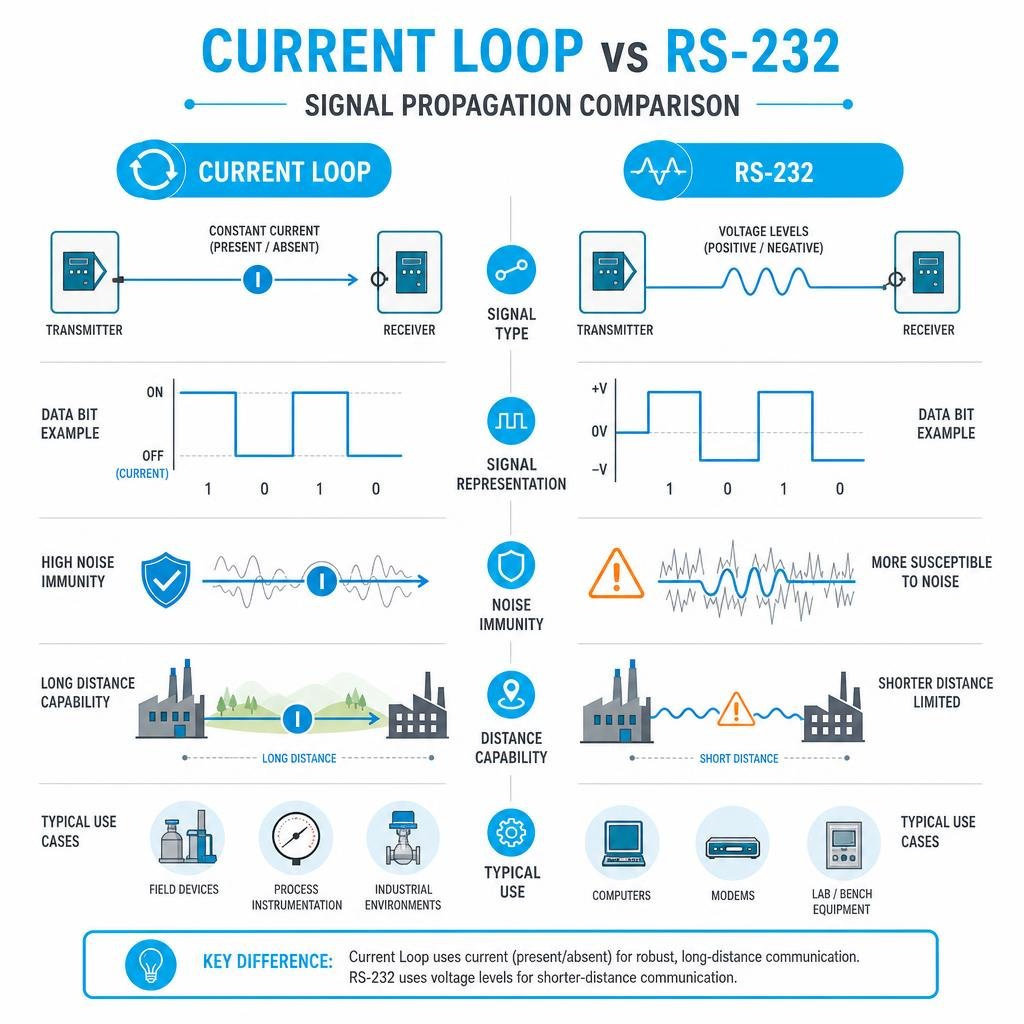
RS-232, a long-standing standard, relies on voltage-based signaling, which can be susceptible to noise and signal degradation over distance. Conversely, current loop technology, developed for its robustness, transmits data using the presence or absence of electrical current, offering superior noise immunity and longer transmission capabilities. The choice between these two often depends on the specific application’s environmental demands and distance requirements.
Understanding Current Loop and RS-232 Technologies
To appreciate the necessity of conversion, understand the fundamental differences between current loop and RS-232. Both are physical layer standards for serial data transmission, but their operational principles are distinct.

RS-232, primarily a voltage-based signaling standard, uses varying voltage levels to represent binary data. A positive voltage (e.g., +3V to +15V) typically signifies a logical ‘0’ (space), while a negative voltage (e.g., -3V to -15V) represents a logical ‘1’ (mark). This voltage-based approach makes RS-232 suitable for shorter distances and relatively clean electrical environments. However, in industrial settings where electromagnetic interference (EMI) is prevalent, voltage signals can be easily corrupted. Additionally, voltage drops over long cables limit RS-232’s effective transmission distance. For a deeper dive into the specifics of this widely used interface, you can explore resources detailing About RS-232 Devices.
Current loop, on the other hand, employs current-based signaling. Instead of voltage, it uses the presence or absence of a specific current level (typically 20mA, 30mA, or 60mA) to represent binary data. For instance, 20mA might represent a logical ‘1’ and 0mA (or a lower current) a logical ‘0’. This method offers significant advantages in industrial environments:
- Noise Immunity: Current loops are inherently more resistant to electrical noise and EMI. Current flowing in a loop is less affected by external voltage fluctuations or induced noise than voltage levels.
- Ground Loop Prevention: By using current rather than voltage, current loop interfaces can often mitigate issues arising from ground potential differences between connected devices, which can cause significant problems for voltage-based systems.
- Extended Distance: The consistent current flow allows for much longer transmission distances compared to RS-232, making it ideal for sprawling industrial facilities.
Why Convert? Bridging the Gap in Industrial Communication
The primary reason for converting between current loop and RS-232 is interoperability. Many modern computing systems, PLCs, and human-machine interfaces (HMIs) utilize RS-232 ports. However, a vast installed base of industrial sensors, actuators, and legacy equipment still relies on current loop interfaces due to their robust nature.
Conversion allows:
- Integration of Legacy Systems: Connecting older current loop devices to contemporary RS-232-equipped computers or control systems.
- Distance Extension: Utilizing the current loop’s long-distance capabilities to extend RS-232 communication over several kilometers in electrically noisy environments.
- Enhanced Reliability: Benefiting from the current loop’s superior noise immunity in challenging industrial settings while still interfacing with standard RS-232 hardware.
Comparing Signal Characteristics in Industrial Measurement
Understanding the distinct signal characteristics of RS-232 and digital current loop is crucial for effective system design and troubleshooting. While both facilitate serial data, their physical implementation differs significantly.
Feature RS-232 Digital Current Loop (e.g., 20mA) Signaling Method Voltage-based (differential) Current-based (unipolar) Voltage Levels +/- 3V to +/- 15V (e.g., +12V for ‘0’, -12V for ‘1’) Up to 30VDC open circuit (current presence/absence) Current Levels Negligible 20mA, 30mA, or 60mA for ‘1’, 0mA for ‘0’ Noise Immunity Moderate, susceptible to EMI High, robust against EMI and ground loops Max. Data Rate Up to 115.2 kbps (practical) Up to 19.2 kbps Max. Distance ~15 meters (50 feet) Up to 6.4 km (4 miles) over 24 AWG twisted pair Wiring Typically 3-5 wires 2-wire or 4-wire Applications PC peripherals, short-distance industrial Industrial control, long-distance data acquisition Digital current loops typically operate with unipolar current, meaning current is either present (e.g., 20mA) or absent (0mA), or sometimes at two distinct levels (e.g., 20mA and 10mA). Common current levels include 20mA, 30mA, or 60mA. This differs from analog 4-20mA loops, which are used for continuous sensor measurements, where 4mA represents the minimum value and 20mA the maximum. While both involve current, their purpose and data representation are different. For more information on analog current loops, refer to discussions on Basic 4-20 mA Current Loops.
The maximum transmission distance for current loop interfaces is impressive. Converters can support distances up to 4 miles (6.4 km) over two 24 AWG twisted pair cables. However, this distance is inversely proportional to the data rate. For instance, at 9600 bps, the practical maximum distance is around 300-400 meters, while at a slower 300 bps, it can extend to 1000-3000 meters using 24 AWG solid copper wire. The typical maximum data rate for current loop converters is 19.2 kbps.
Active versus Passive Operating Modes
One of the most critical distinctions in current loop technology is between active and passive operating modes. This determines which device in the communication link supplies the electrical current for the loop.
- Active Port (Current Source): An active port is a device that provides the necessary current to power the current loop. It acts as the “source” of the 20mA (or 30mA/60mA) signal. If a current loop port is active, it will generate a DC voltage across its output terminals when nothing is connected.
- Passive Port (Current Sink): A passive port, conversely, does not supply current. Instead, it acts as a “sink,” relying on an external or active device to provide the current. A passive port typically presents a low impedance path for the current to flow through.
Determining Port Type: To determine if a current loop port is active or passive, you can perform a simple test:
- Consult Documentation: Always check the device’s manual first. It should specify whether the port is active or passive.
- Voltmeter Test: If documentation is unavailable, break the loop and use a DC voltmeter to measure the voltage across the transmit (T+/T-) or receive (R+/R-) pairs of the port.
- If you measure a significant DC voltage (e.g., 10V to 30V), the port is likely active (a current source).
- If you measure little to no voltage (e.g., near 0V), the port is likely passive (a current sink).
Converter Operation: Current loop to RS-232 converters are often designed to operate in both active and passive modes.
- When connected to an active current loop port, the converter typically operates in passive mode, sinking the current provided by the active port.
- When connected to a passive current loop port, the converter must operate in active mode, supplying the loop current itself. This usually requires an external power supply for the converter (e.g., 12VDC to 30VDC). Some port-powered converters can draw enough power from the RS-232 line to supply a passive loop, but this is less common for higher current requirements.
A crucial rule in current loop systems is that only one device in a given loop (transmit or receive) should be active. Connecting two active devices to the same loop can lead to permanent damage to both devices as they attempt to drive current against each other. Similarly, two passive devices will result in no current flow and thus no communication. Understanding these modes is vital for proper setup and avoiding equipment failure. For complex current loop setups, especially those involving 4-20mA signals, managing the “burden” or impedance can be critical, as discussed in resources like Reducing Burden in a 4-20mA Loop.
Implementing Current Loop to RS-232 Conversion
Implementing a current loop to RS-232 conversion requires a dedicated converter device. These converters act as a bridge, translating the current-based signals of the current loop into the voltage-based signals of RS-232, and vice-versa.
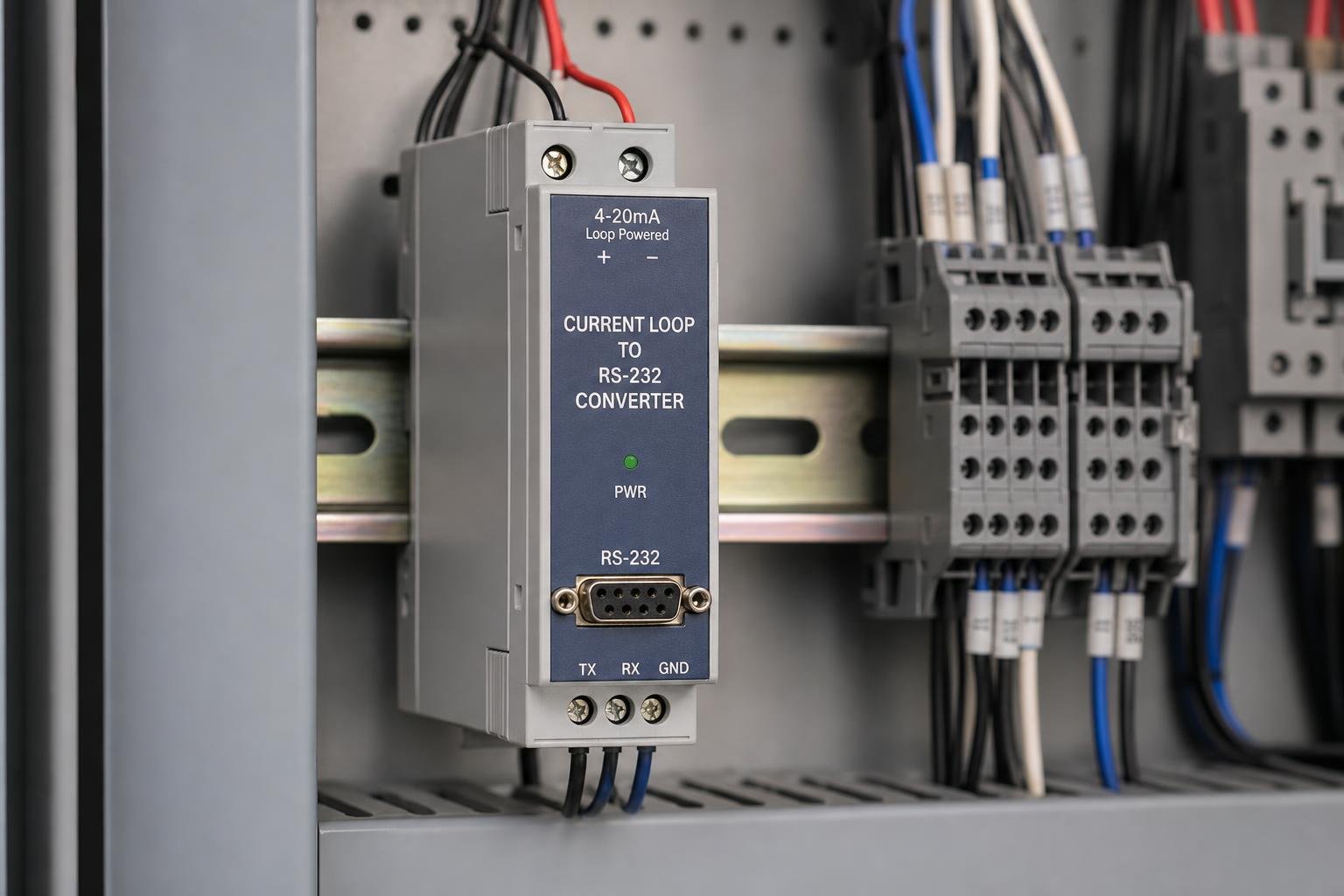
Key considerations for converter implementation include:
- Signal Translation: The primary function is to accurately translate the binary ‘1’ and ‘0’ representations between the two standards.
- Optical Isolation: Many high-quality industrial converters incorporate optical isolation. This feature uses light to transmit signals across a galvanic barrier, effectively separating the electrical grounds of the current loop and RS-232 sides. This eliminates ground loops, which are a common source of noise and interference in industrial environments, and provides robust protection against voltage transients and surges. Converters with 2000V isolation ratings are common, offering significant transient protection.
- Baud Rate Compatibility: The converter must support the required data rates (baud rates) for both the current loop and RS-232 devices. As noted, current loop typically supports up to 19.2 kbps.
- Power Requirements: Depending on whether the converter needs to operate in active or passive mode, it may require an external power supply. Some compact, port-powered converters can draw power directly from the RS-232 DTR or RTS lines, but these might have limitations on the current they can supply to an active loop. For robust industrial applications, a UL-rated, isolated current loop converter, such as those detailed in the UL Rated, Isolated Current Loop Converter documentation, often provides the necessary reliability and protection.
Wiring Configurations for Two-Wire and Four-Wire Loops
Current loop interfaces can utilize either two-wire or four-wire configurations, each serving different communication needs.
- Four-Wire Current Loop: This is the most common configuration for full-duplex communication, where data can be transmitted and received simultaneously. It uses two separate twisted pairs: one pair for transmitting data (T+/T-) and another for receiving data (R+/R-).
- Wiring: For full-duplex, the transmit pair of one device connects to the receive pair of the other, and vice-versa. For example, T+ to R+, T- to R- between two converters.
- Advantages: Allows simultaneous bidirectional communication, simplifying protocol design.
- Two-Wire Current Loop: This configuration uses a single pair of wires for both transmit and receive functions. It is typically used for half-duplex (data in one direction at a time) or simplex (data in only one direction) communication.
- Wiring: The single wire pair carries the current for both directions, often requiring more complex control logic to manage direction.
- Advantages: Reduces cabling requirements.
- Considerations: While 2-wire setups are common for analog 4-20mA sensors, digital 2-wire current loop for serial data is less prevalent but does exist, often requiring careful consideration of timing and current modulation.
When connecting a current loop converter, it’s crucial to correctly identify the transmit and receive lines (T+, T-, R+, R-) and ensure proper polarity. Most converters provide terminal blocks for easy and secure wiring. Detailed wiring diagrams and switch configurations are typically found in the converter’s user manual, such as the BLACK BOX RS-232 Current Loop Interface Converter 232/CL-E User Manual.
Testing and Verifying Active Loop Ports
Before connecting a current loop converter, it is paramount to determine if the existing current loop port is active or passive. As mentioned, connecting two active devices can cause damage.
Here’s how to test and verify:
- Voltmeter Test: Disconnect the current loop wires from the device in question. Use a DC voltmeter to measure the voltage across the transmit (T+/T-) or receive (R+/R-) terminals. If you read a significant DC voltage (e.g., 10V to 30V), the port is active. If the voltage is near zero, it’s passive.
- LED Diagnostics: Some current loop devices and converters include LED indicators for transmit (TX) and receive (RX) activity. If an active device is connected, the TX LED might be continuously lit, indicating current flow.
- Manufacturer Documentation: The most reliable method is always to consult the manufacturer’s manual for the device you are connecting to.
- Loopback Testing: Once a converter is installed, you can perform a loopback test to verify its functionality. This involves connecting the converter’s transmit output directly to its receive input (e.g., T+ to R+ and T- to R-). Then, using a terminal program on the RS-232 side, send characters. If the characters are echoed back correctly, the converter is functioning. Some converters might have a dedicated test mode or require specific software (like a
CURTEST.EXEutility mentioned in some older manuals) to facilitate this. - Single Active Device Rule: Always remember that for any given transmit or receive loop, only one device should be supplying current (active). The other device should be configured as passive to sink that current. This prevents potential damage and ensures proper communication.
Key Features of a Current Loop to RS-232 Converter
When selecting a current loop to RS-232 converter, several key features contribute to its performance, flexibility, and reliability in industrial applications:
- Active/Passive Selectability: The ability to configure both the transmit and receive loops independently as active (current source) or passive (current sink) is crucial for interoperability with various current loop devices.
- DTE/DCE Selection: Converters should offer configuration options for Data Terminal Equipment (DTE) and Data Communication Equipment (DCE) roles on the RS-232 side. This allows the converter to correctly interface with different types of RS-232 devices without requiring null modem cables. This is often achieved via DIP switches or jumpers.
- DIP Switch Configurations: Flexible DIP switches or jumpers allow users to set parameters such as baud rate, data bits, parity, stop bits, DTE/DCE mode, and active/passive loop current levels (e.g., 20mA, 30mA, 60mA).
- Connector Types: Common connectors include DB9 or DB25 for the RS-232 side and screw terminal blocks for the current loop side, facilitating robust industrial wiring.
- Optical Isolation: As discussed, optical isolation is a critical feature for protecting equipment from ground loops, voltage surges, and electrical noise.
- Wide Operating Temperature Range: Industrial environments can be extreme. Converters designed for a broad temperature range (e.g., -40°C to +80°C) ensure reliable operation in harsh conditions.
- High MTBF (Mean Time Between Failures): A high MTBF rating indicates a robust and reliable device, essential for critical industrial applications where downtime is costly.
- Asynchronous Communication Support: Converters are designed for asynchronous serial communication, supporting standard data formats with start and stop bits.
Practical Applications in Industrial Measurement Systems
The ability to convert between current loop and RS-232 interfaces enables a wide array of practical applications, particularly in scenarios involving legacy systems, long distances, or noisy environments.
- Legacy Computer Interfacing: Many older industrial control systems, CNC machines, and specialized scientific instruments utilize current loop interfaces. Converters allow these systems to communicate with modern PCs or PLCs that primarily use RS-232 ports, extending the lifespan of valuable legacy equipment.
- Teleprinter Systems: Historically, current loop was widely used for teleprinters and teletype machines. Converters facilitate the integration of these vintage devices into modern digital networks for historical preservation or niche applications.
- Liquid Flow Monitoring and Environmental Data Loggers: In remote monitoring stations for water treatment, environmental sensing, or pipeline management, current loop’s long-distance capability is invaluable. Converters allow data from current loop sensors to be transmitted over kilometers to a central RS-232-equipped data logger or control unit.
- PLC Integration: Programmable Logic Controllers (PLCs) are the backbone of industrial automation. While many newer PLCs offer Ethernet or RS-485, older models or specific I/O modules might still use current loop. Converters enable seamless integration with RS-232 compatible PLC communication ports.
- Factory Floor Automation: In large manufacturing facilities, electrical noise from motors, machinery, and power lines can wreak havoc on voltage-based signals. Current loop provides a reliable communication backbone in these environments, with converters allowing interface with supervisory control systems.
- Test and Measurement Equipment: Certain specialized test and measurement devices might employ current loop for robust data acquisition, especially in electrically noisy test setups. Converters bridge these to standard computer interfaces for data analysis.
For more detailed examples and technical guidance on communication strategies in industrial settings, exploring various Application Notes – Communication can provide invaluable insights.
Current loop to RS-232 converters serve as critical components in maintaining the operational integrity and extending the utility of diverse industrial measurement and control equipment in an ever-evolving technological landscape.