
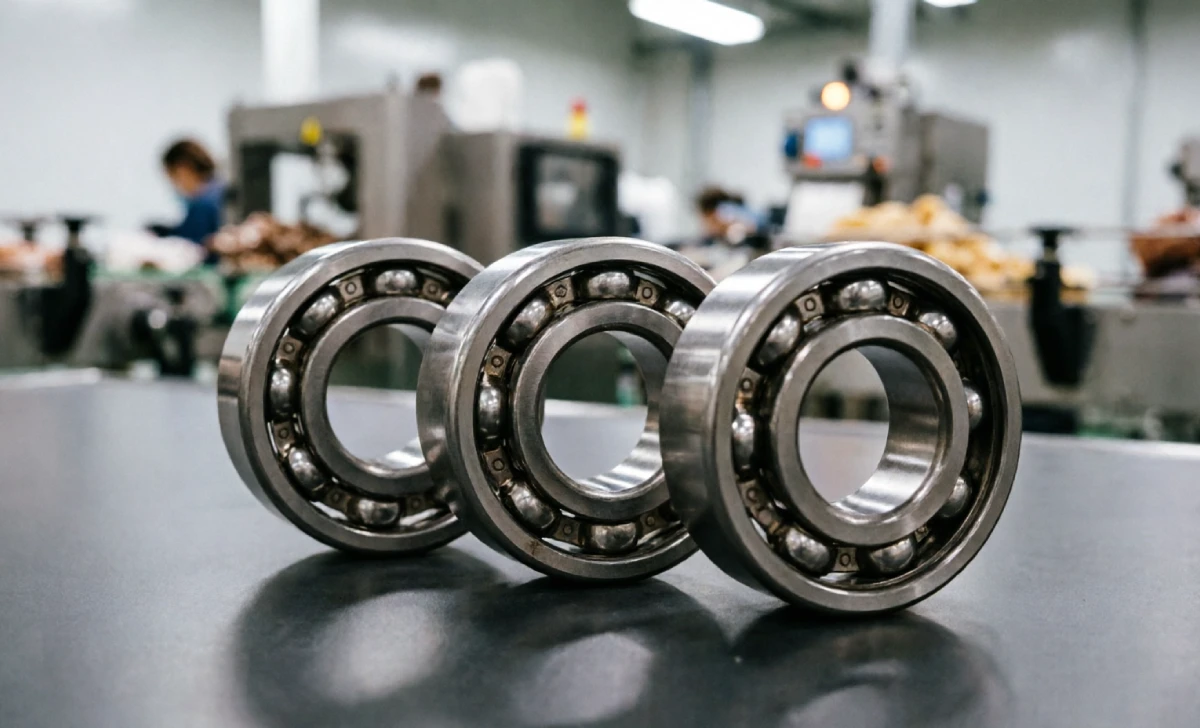
If you’ve ever worked with machinery, conveyor systems, or food processing equipment, you know how important bearings are. They keep things moving smoothly. But if you’ve ever dealt with rust, frequent replacements, or unexpected downtime, you’ve probably asked yourself: Is there a bearing that lasts longer in wet or harsh environments?
That’s where stainless steel roller bearings come in.
In this guide, we’ll walk through everything you need to know: what makes them different from chrome steel, when to use them, their real-world limitations, and why they might be the right choice for your application.
What Are Stainless Steel Roller Bearings?
Stainless steel roller bearings are rolling-element bearings designed to handle moderate radial loads and thrust loads while resisting rust and corrosion. Unlike standard bearings made from chrome steel (like 52100 bearing steel), these use stainless steel alloys—most commonly 440C stainless steel—which contain higher chromium content.
That extra chromium isn’t just a marketing point. It actually combines with nickel to form a passive film on the surface. This thin, invisible layer protects the bearing from moisture, chemicals, and other corrosive elements. In simple terms, stainless steel roller bearings keep working long after regular bearings would have seized up.
But they’re not perfect for every job. Understanding their strengths and weaknesses is key to making the right choice.
Why Corrosion Resistance Matters More Than You Think
One of the most common questions engineers ask is: How much more corrosion-resistant are stainless steel bearings compared to chrome steel?
The answer comes down to chemistry. Stainless steel contains more chromium than chrome steel. That chromium reacts with oxygen to form the passive film we mentioned. If the surface gets scratched, the film naturally reforms. Chrome steel can’t do that.
However, there’s a trade-off. Stainless steel is generally softer than hardened chrome steel (52100 bearings). As a result, the load-carrying capacity of stainless steel roller bearings is roughly 20% lower than that of their chrome steel counterparts.
So if your application involves heavy loads and no moisture risk, chrome steel might still win. But if you’re dealing with washdowns, humidity, or corrosive chemicals, stainless steel is the clear choice.
A Note on Coatings
Some manufacturers try to bridge the gap by using zinc-nickel-plated layers on standard steel bearings. The outer ring and inner ring get coated to form a physical barrier. While this helps, it’s not a perfect solution. The plating process can leave tiny holes (porosity) that become foci for corrosive activity. Over time, rust can start from those microscopic weak points. Stainless steel avoids this problem entirely because the corrosion resistance is built into the material itself, not just a surface layer.
Durability and Robustness: Built to Last
Another common user concern is: Will stainless steel roller bearings crack or fail under repeated stress?
Stainless steel is a solid and durable alloy. Engineers design finished components with a specific hardness that resists cracking and subsurface rolling contact fatigue. That’s a fancy way of saying the material handles repeated stress well without developing microscopic cracks beneath the surface.
In fact, stainless steel roller bearings are naturally suited for applications with heavy loads—within their rated capacity—and their high corrosion resistance makes them ideal for food-oriented environments.
Real-World Example: Food Processing
If you’ve ever worked in a meat-packing or dairy facility, you know how brutal the environment is on equipment. High-pressure washdowns, acidic fluids (like those found in meat), and strict sanitation requirements destroy ordinary bearings quickly.
Stainless steel roller bearings solve multiple problems at once:
- They’re easy to clean, so bacteria won’t stick to surfaces.
- They resist acidic fluids.
- They don’t require additional coatings that can chip or wear off.
That’s why you’ll often find them in food-processing equipment, pharmaceutical manufacturing, and marine applications.
Crowned Diameter: What It Is and Why It Matters
If you’ve ever compared a standard roller bearing to a stainless steel one, you might have noticed a subtle design difference: the crowned diameter.
Most steel rollers and pins have a consistent outside diameter (OD) from end to end. But stainless steel roller bearings often use a crowned profile. That means the rolling element has a constant OD in the center section, but the diameter drops slightly at the ends.
Why does that matter?
Without crowning, the ends of the roller carry higher stress than the middle. That leads to premature wear and eventual failure. A crowned diameter avoids higher stresses at the ends by distributing the load more evenly across the roller’s length. Multiple grinding processes achieve these crowned profiles, and it’s a sign of a well-engineered bearing.
Madewell Crown Rollers Example
Some manufacturers, like Madewell, produce crown rollers that are linear guide bearings with a curved outer diameter and integrated mounting studs. These provide smooth, guided motion without needing to re-align the linear guide surfaces. They’re quiet, designed for a fixed location, and feature an offset pilot diameter with permanently attached polymer over-molded stainless steel single-row ball bearings with shields.
If you need precision in your application—like automated assembly or packaging equipment—these crowned designs are a great choice.
Handling Moderate Thrust and Radial Loads at Low Operating Torque
A question that comes up often in maintenance forums is: Can stainless steel roller bearings handle both radial and thrust loads at the same time?
The short answer is yes—within limits.
Stainless steel roller bearings are excellent for moderate thrust and radial loads at lower operating torques. They feature ground transition raceways, which deliver higher thrust load capacity while reducing edge stresses. A modified polyamide/brass cage geometry promotes higher speed ratings and reduced heat generation.
Newer manufacturing techniques include state-of-the-art heat-treating techniques that minimize dimensional changes in balls with low oxygen content. These improvements ensure longer bearing life and reduced fatigue failure.
Which Type Should You Choose?
Stainless steel roller bearings come in several configurations:
- Single-direction or double-direction, depending on whether loads come from one side or both.
- Spherical roller bearings for applications with misalignment.
- Needle-shaped roller bearings for compact, high-load designs.
Ball bearings (a subset of roller bearings) concentrate forces onto a limited number of contact points. That’s great for moderate thrust and radial loads at low operating torques, but they can fail quickly under high loads. The small contact point between balls and races reduces friction, enabling high speeds—but that same design becomes a weakness under heavy stress.
So if your application involves high speeds with lighter loads, ball-style stainless steel roller bearings work well. For heavier, slower loads, consider a full roller design.
Low Coefficient of Friction: What Does That Mean for You?
The coefficient of friction is a measurement used to describe the resistance created by the sliding motion of two moving parts. In bearings, lower friction means less heat, less wear, and longer life.
Stainless steel roller bearings are designed to maintain a naturally low coefficient of friction. The materials used (typically 440C stainless steel) have good sliding properties against hardened races. That means your equipment runs cooler and more efficiently.
However, don’t assume “low friction” means “no lubrication.” Even stainless steel bearings need proper lubrication to perform their best. The difference is that if lubrication breaks down temporarily, stainless steel bearings are less likely to gall or seize compared to chrome steel.
A Word of Caution
The original article you might have seen elsewhere makes a confusing claim: that stainless steel roller bearings are not suitable for swimming pools or food processing. That’s actually incorrect based on industry standards. In reality, stainless steel bearings are widely used in both swimming pool equipment (pump bearings exposed to chlorinated water) and food processing (washdown environments). The confusion likely comes from comparing them to specialized plastic or ceramic bearings for extreme chemical exposure.
For 99% of industrial applications, stainless steel roller bearings are perfectly suitable.
Where Should You NOT Use Stainless Steel Roller Bearings?
Honesty matters. Stainless steel roller bearings aren’t always the right answer.
Avoid them when:
- You need maximum load capacity. Chrome steel 52100 bearings can handle about 20% higher loads.
- Cost is the only factor. Stainless steel is more expensive than chrome steel.
- Extreme high speeds with minimal load. In that case, ceramic hybrid bearings might be better.
- Highly acidic chemical baths. Specialty plastics or ceramics may be required.
For medical applications, stainless steel is often used, but it must meet specific grades (like 316 for implantable devices). Standard 440C is fine for surgical tools and equipment frames, but not internal implants.
Summary: Why Choose Stainless Steel Roller Bearings?
Let’s bring it all together.
Stainless steel roller bearings offer a range of advantages that make them a top choice for many applications:
- Impressive corrosion resistance thanks to high chromium content and self-healing passive film.
- Durability and robustness that resists cracking and subsurface rolling contact fatigue.
- Crowned diameter design that distributes stress evenly and avoids end-loading.
- Smooth operation under moderate thrust and radial loads even at low operating torques.
- Low coefficient of friction for cooler, more efficient running.
While they may not be ideal for extremely high-load or ultra-high-speed scenarios, stainless steel roller bearings provide a dependable and cost-effective solution for countless industrial and commercial uses—especially where moisture, chemicals, or sanitation requirements are present.
As engineers and manufacturers continue to recognize the benefits of this material, stainless steel roller bearings will likely remain a popular choice for years to come.
Frequently Asked Questions
Are stainless steel roller bearings completely rust-proof?
No bearing is 100% rust-proof in all conditions. But stainless steel roller bearings are highly rust-resistant and will outperform chrome steel in wet or humid environments.
Do I need to lubricate stainless steel bearings?
Yes. Lubrication reduces friction, removes heat, and extends life. Stainless steel doesn’t eliminate the need for proper maintenance.
Can I replace chrome steel bearings with stainless steel without changing other components?
Usually, yes, as long as the load rating matches your application. Remember, stainless steel has ~20% lower load capacity than 52100 chrome steel.
Are stainless steel roller bearings food-safe?
Yes, when properly cleaned. They’re widely used in food-processing equipment because they resist acidic fluids and are easy to sanitize.