
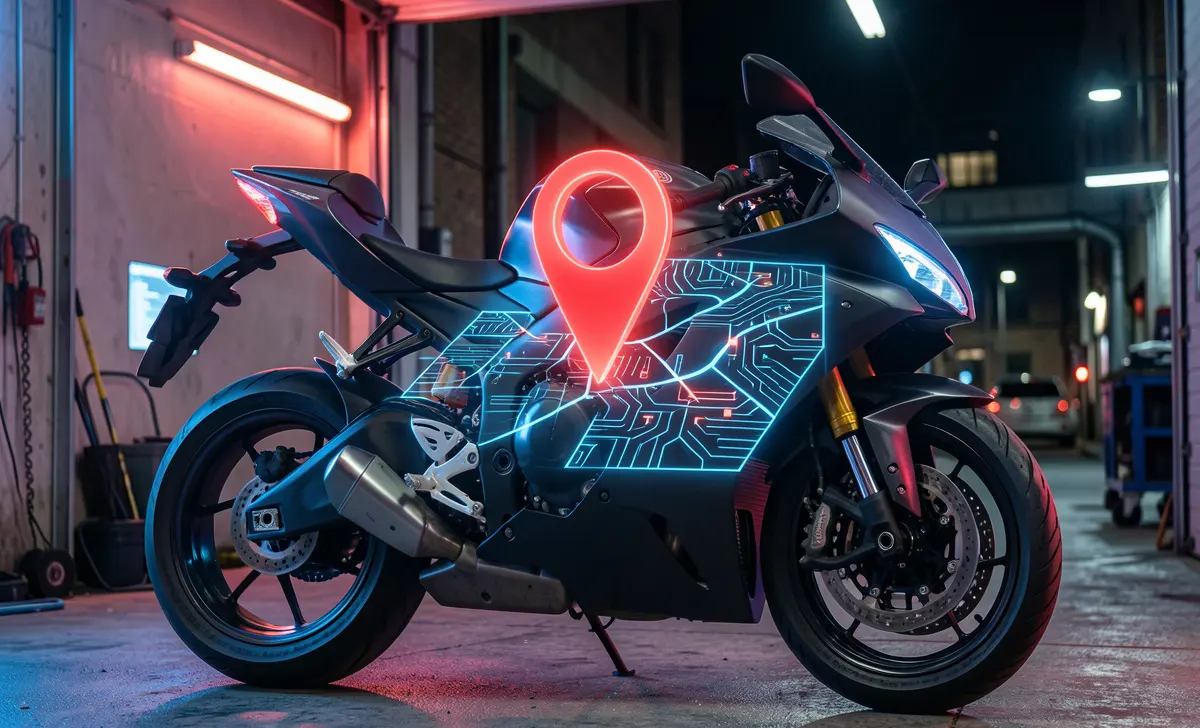
Let’s be honest—there’s no sinking feeling quite like walking back to where you parked your bike and finding nothing but a space. Maybe some broken glass. Maybe just… nothing.
I’ve been there. Not with a bike, but with a car years ago. And the helplessness sticks with you. The questions come fast: When did it happen? Who took it? Is it already in a shipping container headed overseas?
Here’s the hard truth: It takes an average of just 20 seconds to steal a motorcycle. Twenty seconds. That’s less time than it takes to make a cup of tea. In the UK alone, there were nearly 16,000 reported motorcycle thefts in 2024. And those are just the reported ones.
So what do you do? You can’t sleep next to your bike every night. You can’t chain it to your wrist. But you can fit it with something that whispers its location back to you, no matter where it goes.
That’s where motorcycle GPS trackers come in. And in this guide, we’re going to cover exactly how they work, whether they’re worth your money, and what the heck all those technical specs actually mean for you as a rider.
What Is a Motorcycle GPS Tracker, Really?
Think of a GPS tracker as a tiny, hidden guardian angel that never sleeps. It’s a device—usually small enough to fit in your palm—that sits somewhere on your bike, constantly figuring out where it is and reporting back to you.
But here’s the thing that surprises most people: it’s actually two technologies working together. The GPS part figures out the location by talking to satellites. The cellular part (yes, it has its own SIM card, just like your phone) sends that location to you.
So when your bike moves unexpectedly, the tracker doesn’t just sit there silently. It calls you. It texts you. It shows you exactly where your bike is on a map, often within 2-5 meters of accuracy.
Some of the better systems—like those certified by Thatcham Research—even have a professional monitoring team watching your bike 24/7. If it moves without you, they get the alert. They call you. And if it’s stolen, they liaise directly with the police. You don’t have to convince a dispatcher to take you seriously at 3 a.m. It’s already done.
How Does a Motorcycle GPS Tracker Actually Work?
Let’s pull back the curtain a bit. The technology sounds complicated, but the basic idea is surprisingly simple.
The Satellite Dance
Your tracker contains a GPS receiver. This receiver is constantly listening for signals from a network of satellites orbiting Earth. By calculating how long it takes for signals from at least four different satellites to arrive, the device can pinpoint its exact location—latitude, longitude, even altitude.
This is why GPS works in the middle of nowhere. As long as the tracker can “see” the sky, it generally knows where it is. In open areas, it can work effectively for hundreds of miles.
The Cellular Connection
Knowing where it is doesn’t help you unless that information reaches your phone. That’s where the cellular modem comes in.
Most modern trackers have a built-in SIM card (often an eSIM these days) that connects to cellular networks—the same ones your mobile phone uses. The tracker takes its GPS coordinates and sends them over this cellular connection to a cloud server. Your phone pulls that data from the server and shows you a dot on a map.
This is why some trackers struggle in areas with poor cell reception. The GPS might know exactly where your bike is, but if it can’t tell you, it doesn’t help much.
The Clever Part: Motion Sensing
Here’s where it gets really smart. Modern trackers don’t just sit there broadcasting your bike’s location constantly—that would kill the battery. Instead, they use built-in motion sensors (accelerometers) to detect movement.
When you park your bike and walk away with the key fob, the tracker goes into “armed” mode. It’s sleeping lightly, listening. The moment someone touches your bike—maybe they rock it, maybe they lift it into a van—the tracker feels that vibration.
And then it wakes up. It starts broadcasting. It calls you. It texts you. It does everything it can to scream “SOMEONE IS TAKING YOUR BIKE”.
Some systems are so sensitive that they can distinguish between a strong wind rocking the bike and an actual theft attempt. Others let you adjust the sensitivity so your bike doesn’t alert you every time a truck rumbles past.
Geofencing: Virtual Walls
Most trackers also let you set up “geofences”—virtual boundaries on a map. You might draw a circle around your neighborhood, or around the coffee shop where you stop every Sunday.
If your bike crosses that boundary without you? Alert. Immediately.
This is incredibly useful if you lend your bike to a friend (you’ll know if they go somewhere they shouldn’t) or if a thief manages to move it slowly, hoping not to trigger a motion alert.
Are Motorbike Trackers Worth It?
This is the million-pound question, isn’t it? Let’s look at this honestly.
The Cost Reality
A decent tracker will set you back anywhere from £130 to £400 for the hardware, plus an annual subscription of £40 to £100. Over three years, you’re looking at £250–£700.
That’s not pocket change. So what do you actually get?
The Cold, Hard Statistics
That 20-second theft statistic I mentioned earlier? That’s from the National Crime Intelligence Service. Twenty seconds is all it takes. A disc lock might add ten seconds. A chain might add thirty. But a tracker? A tracker means that even if they succeed, they haven’t really won.
The same data shows that vehicles without tracking are recovered at abysmally low rates. Vehicles with tracking? The recovery rates climb dramatically, especially with professionally monitored systems.
The Real-World Test Results
Independent tests tell the story clearly. In controlled theft simulations, proper GPS trackers alerted owners within 44 to 69 seconds of the bike being disturbed. Not minutes. Seconds.
The bike hadn’t even made it into the thief’s van before the owner knew something was wrong. That kind of response time changes everything. If you’re close enough, you might actually interrupt the theft in progress.
Compare that to cheaper “solutions” like Apple AirTags, which, in the same test, never alerted the owner at all. The bike was gone, and the owner had no idea until they walked back to a space.
The Insurance Angle
Here’s something most riders don’t consider: insurance companies love trackers.
Many insurers will reduce your premium if you fit a Thatcham-approved tracker. Over a few years, those savings can offset a significant chunk of the tracker’s cost. Some high-value bikes or riders with a claims history may even require a tracker to get insured at all.
Thatcham Research is the independent body that certifies security devices in the UK. If a tracker is Thatcham-approved (like the S5 category), insurers recognize it as legit. They trust it. And they reward you for having it.
What Do Thieves Actually Do With Stolen Motorbikes?
Understanding your enemy helps you defend against them. So let’s talk about what happens after a bike gets lifted.
The Method: Hot-Wiring and Beyond
Despite what movies show, hot-wiring modern bikes isn’t as simple as crossing two wires. Most bikes now have immobilizers—electronic chips in the key that must be recognized before the engine will start.
But thieves adapt. Some will bypass the ignition entirely. Others will lift the bike into a van—no engine start required. This is why motion sensors matter so much. Your bike might never start its engine, but if it’s rolling into a van, you need to know.
In some cases, thieves will quickly strip a bike for parts—fairings, wheels, engines—all of which can be sold separately. This is why response time is everything. If you don’t know your bike is gone for hours, those parts could already be scattered across the country.
The Destination
Stolen bikes go one of three places:
- Containers for export – Loaded up and shipped overseas within days, sometimes hours.
- “Cooling off” locations – Stashed in a garage or storage unit for weeks or months to see if they’re tracked before being broken down or sold.
- Immediate chop shops – Stripped for parts that are sold individually.
This is why trackers with historical location data are so valuable. Even if you don’t catch the thief in progress, knowing where the bike has been can lead police to the thieves’ operation.
How Far Can a GPS Tracker Work?
This question comes up constantly, and the answer isn’t as simple as “50 miles” or “100 miles.”
It Depends on Cellular Coverage
The tracker itself doesn’t have a “range” in the traditional sense. Your tracker talks to satellites that are literally in space. Those satellites don’t care if your bike is in London or Land’s End. So the GPS part works everywhere with a clear view of the sky.
The limitation is the cellular network. The tracker needs to send its location data over mobile networks. If your bike is in a remote area with no signal, the tracker will store the location data internally (some can store up to 10,000 records) and transmit it as soon as it reconnects.
So the real answer is: your tracker works wherever there’s cellular coverage. In practice, that means across the entire country, and often across Europe if your subscription includes roaming.
The Signal Challenge
There’s a catch, though. GPS signals don’t penetrate metal well. If your bike is in a shipping container or a metal-walled garage, the tracker might not be able to get a GPS fix.
This is why high-end systems use radio frequency (RF) technology as a backup. They can broadcast a signal that recovery teams can follow with direction-finding equipment, even when GPS is blocked. In tests, these systems could pinpoint a bike to within five meters, identifying the exact container out of a row of six.
Hardwired vs. Battery-Powered: Which Should You Choose?
This is one of the most practical decisions you’ll make.
Hardwired Trackers
These connect directly to your bike’s electrical system.
Pros:
- Never need to remember to charge them
- Can be hidden very deeply (no need to access them for charging)
- Often include immobilizer functions that can prevent the bike from starting
- Usually more feature-rich with better monitoring options
Cons:
- Professional installation recommended (costs money)
- Thieves might look for cut wires (though good installers hide them well)
Battery-Powered Trackers
These run on internal rechargeable batteries.
Pros:
- Easy DIY installation (just hide it somewhere)
- No wires for thieves to find and cut
- Portable—move it between bikes easily
- Perfect for classics or off-road bikes where you don’t want to mess with wiring
Cons:
- Must remember to charge every few months
- Battery life varies—some last months, some weeks, depending on usage
- Need to be placed where you can access them for charging (may compromise hiding spots)
In real-world use, a good battery-powered tracker like the Tracking One can last up to four months with regular use, or six months if the bike isn’t moving. That’s not bad—just set a calendar reminder.
What to Look for When Buying a Tracker
Walk into this with your eyes open. Here’s what actually matters.
Thatcham Approval
If insurance savings matter to you, look for Thatcham certification. It’s the gold standard in the UK. Not all trackers have it. The ones that do have been independently tested and verified.
Monitoring vs. Self-Monitored
Some trackers just alert you. You get the text, you call the police, you try to convince them to help.
Others have professional monitoring centers. They get the alert. They call you to verify. They call the police. They work with officers to recover your bike.
The difference is night and day. When you’re panicking at 3 a.m., do you want to be the one managing the recovery, or do you want professionals handling it?
Backup Battery
If a thief cuts your bike’s battery, a tracker without internal backup goes silent instantly. A tracker with a backup battery keeps broadcasting. This is non-negotiable.
Water Resistance
Motorcycles live outside. Your tracker needs to handle rain, pressure washing, and general road grime. Look for IP67 or IPX6 ratings.
Accuracy
Good trackers are accurate to within 2-5 meters in open areas. Some can even pinpoint which side of the street your bike is on. This matters when you’re trying to locate a bike hidden in a backyard or storage unit.
Geofencing
The ability to set virtual boundaries—your home, your work, your friend’s house—and get alerts when the bike crosses them is incredibly useful.
Installation Requirements
Be honest with yourself. Do you want to DIY, or do you want a professional to handle it? Professional installation costs more but ensures the tracker is hidden properly and wired correctly.
Does a Tracker Reduce Motorbike Insurance?
Yes—but with conditions.
If your tracker is Thatcham-approved, many insurers will offer a discount. The discount varies, but it can be meaningful—sometimes 10-20% off your comprehensive premium.
Some insurers require trackers for certain bikes. If you’ve got a high-value machine or a poor claims history, a tracker might be the difference between getting insured and being turned away.
Always check with your insurer before buying. Ask: “What trackers do you approve? What discount do you offer?” The answers will guide your purchase.
The Bottom Line
Look, no tracker is 100% guaranteed to recover your bike. Thieves are clever, and some will find ways around even the best systems.
But here’s what I know: a tracker changes the odds.
Without one, if your bike disappears, it’s probably gone forever. With one, you have a fighting chance. You have data. You have evidence. You have something to hand the police that says, “Here’s exactly where my bike is right now.”
In those twenty seconds it takes to steal a motorcycle, a tracker is your voice that keeps shouting long after the thief has gone silent.
Is it worth it? For me? Absolutely. For you? Only you can decide. But if you’ve ever felt that sickening lurch of realizing something you love has been taken, you already know the answer.